Sep 19, 2026Buying Guides
Trade Show Sourcing Guide: How to Evaluate Hardware Suppliers at Canton Fair, Interzum, and KBIS
Learn how to evaluate cabinet hardware suppliers at major trade shows such as Canton Fair, Interzum and KBIS. Discover what buyers should check, ask and collect before choosing a supplier.
Trade Show Sourcing Guide: How to Evaluate Hardware Suppliers at Canton Fair, Interzum, and KBIS
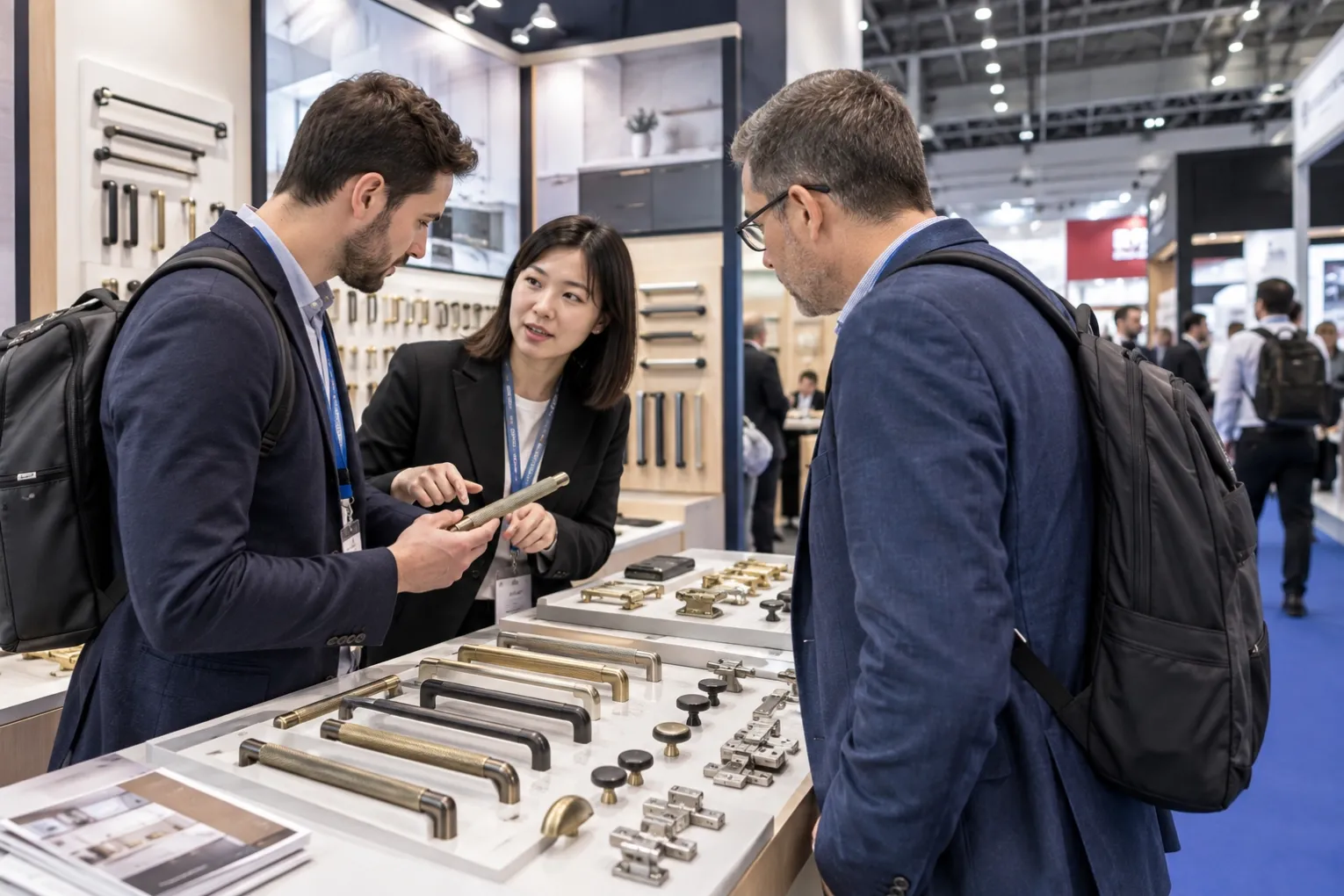
Trade shows such as Canton Fair, Interzum, and KBIS give furniture brands, cabinet manufacturers, distributors and importers an opportunity to meet hardware suppliers face to face.
For buyers, however, walking through a busy exhibition hall can create a new problem: how do you determine which suppliers are actually worth following up with?
A well-designed booth and attractive products can create a strong first impression, but they do not tell you everything about a supplier's capabilities.
The more important questions are about product quality, material, finish options, MOQ, samples, quotation, packaging and whether the supplier can consistently meet your requirements after the show.
This guide explains what professional buyers should evaluate when sourcing cabinet hardware at a trade show.
Why Trade Shows Are Useful for Hardware Sourcing
Meeting suppliers at a trade show provides advantages that are difficult to get from online sourcing alone.
You can directly:
- See actual hardware products
- Compare different designs and finishes
- Touch and evaluate product feel
- Ask questions about materials and production
- Review new product collections
- Request samples
- Discuss MOQ and pricing
- Understand a supplier's product range
- Compare multiple suppliers in a short period
For buyers looking for new furniture hardware, trade shows are also useful for identifying new styles and emerging product directions.
Many suppliers use exhibitions to introduce or promote new products, making the show floor a useful place to discover hardware that may not yet be widely available through standard catalogs.
Don't Choose a Supplier Based Only on Appearance
A professional-looking booth does not automatically mean a supplier is the right partner.
Likewise, the lowest quotation does not necessarily represent the best purchasing value.
When evaluating a hardware supplier, buyers should look at several factors together:
- Product quality
- Material options
- Finish consistency
- Product range
- MOQ
- Sample support
- Quotation
- Packaging
- Payment terms
- Communication
- Ability to meet future product requirements
The goal is not to find the supplier with the most impressive booth.
The goal is to find the supplier that can reliably deliver the hardware your business needs.
1. Evaluate the Actual Hardware Products
Start with the products themselves.
For cabinet hardware, look closely at the shape, proportions, surface quality and overall construction.
If possible, handle the products rather than only looking at them from a distance.
Pay attention to:
- Surface smoothness
- Edge quality
- Overall weight and feel
- Consistency between similar products
- Mounting structure
- Finish appearance
- Design details
A supplier's physical samples can reveal information that is difficult to judge from photographs or a digital catalog.
Look Beyond the Most Attractive Product
Trade show displays are designed to attract attention, so some products may be selected specifically as visual highlights.
Instead of judging the supplier by one attractive handle, ask to see more of the supplier's product range.
A supplier with a broader and well-organized cabinet hardware collection may be better positioned to support a furniture brand with multiple product lines.
2. Ask About Materials
Material is one of the first questions buyers should ask.
For cabinet handles and cabinet pulls, common material options include zinc alloy, aluminum and brass.
Different materials can provide different combinations of:
- Product feel
- Weight
- Appearance
- Price positioning
- Design possibilities
- Size options
Rather than asking only for the cheapest available option, explain your target furniture positioning and ask the supplier which material is appropriate.
For premium furniture, for example, zinc alloy or brass may be considered where a more substantial feel is important.
For lightweight or long-handle applications, aluminum can provide different advantages.
A professional supplier should be able to explain these differences clearly instead of simply giving you a price.
3. Explore Finish Options
Finish is another important factor when evaluating cabinet hardware.
Ask suppliers which finishes are available for the specific products you are interested in.
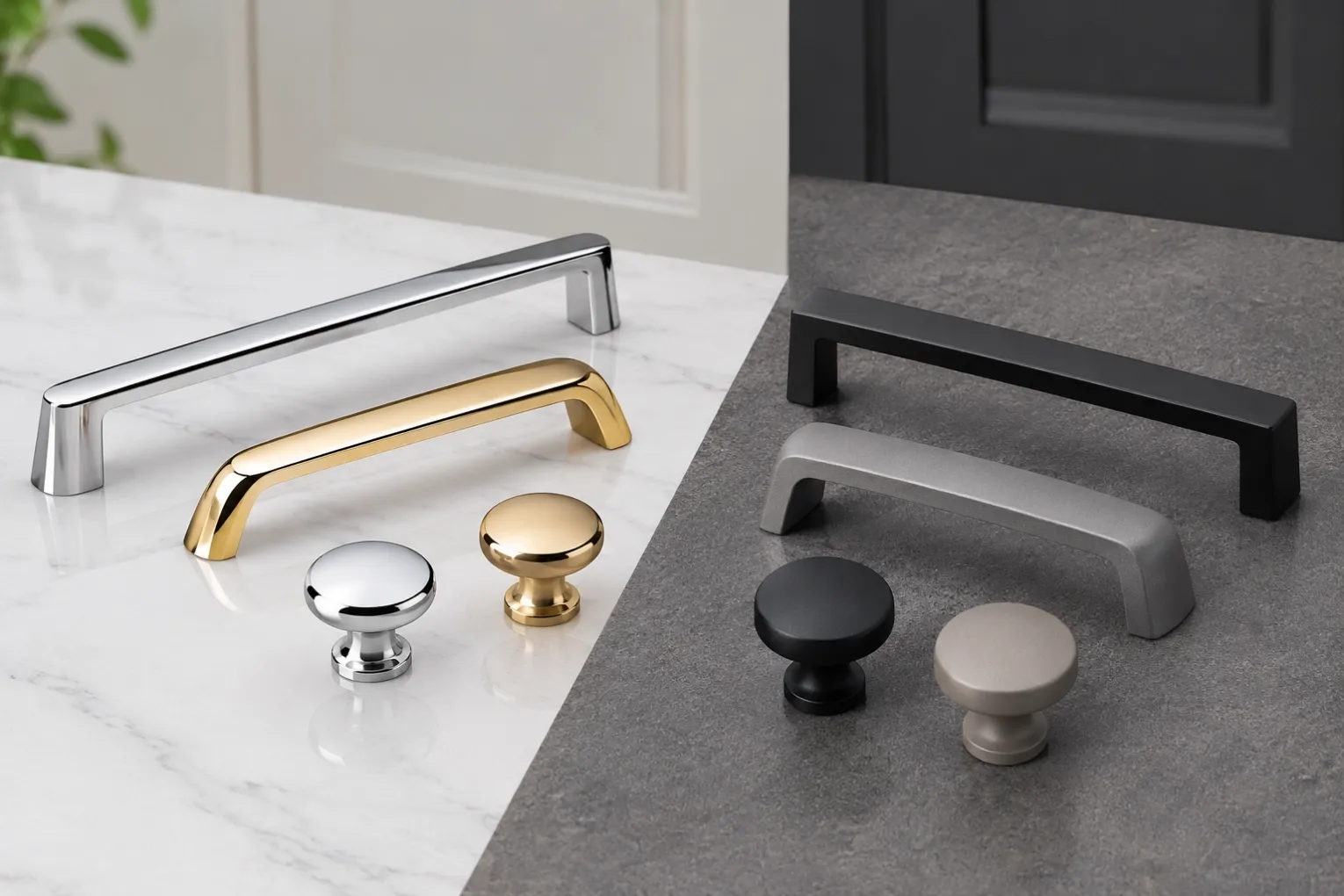
Depending on the product, common options may include:
- Matte Black
- Brushed Gold
- Satin Nickel
- Chrome
- Antique Bronze
- Black Nickel
- PVD
- Other custom colors
Do not assume that every finish can be applied to every product.
Ask which finishes are already available for existing designs and whether custom colors or surface treatments are possible.
Compare Finish Quality, Not Just Finish Names
Two suppliers may use the same finish name while producing noticeably different visual results.
Compare actual samples where possible.
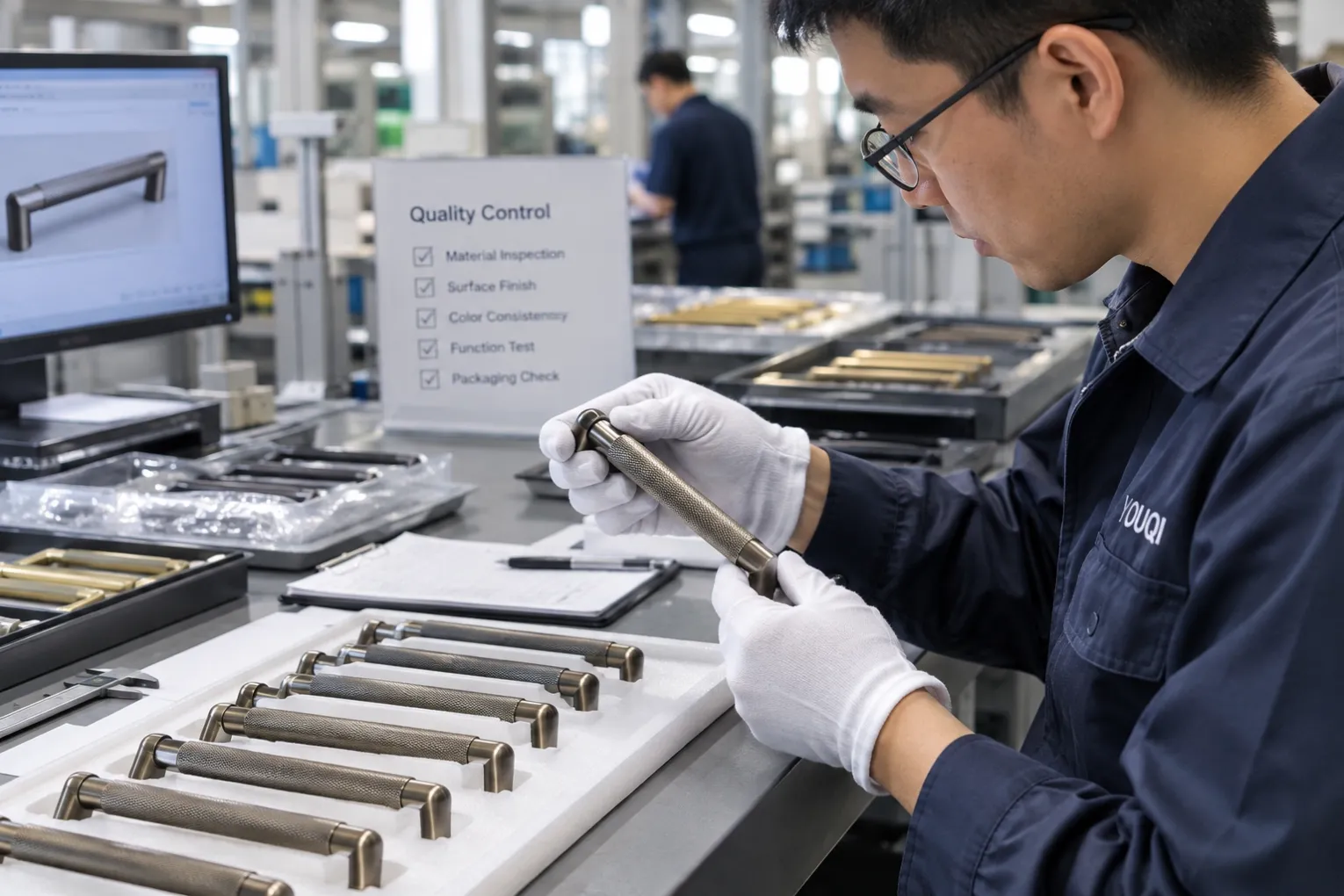
Look for:
- Surface consistency
- Color consistency
- Overall appearance
- Polishing quality
- Finish details around edges and corners
For furniture brands, finish consistency can be just as important as the initial product design.
4. Ask About New Products
Trade shows are particularly useful for discovering new hardware styles.
When visiting a supplier, ask:
“Which products are new or currently being promoted?”
This can help you identify designs that may give your furniture collection a different visual direction.
At YOUQI, the product range covers cabinet handles/pulls, knobs, cup pulls, hinges and other furniture hardware, while new styles can be promoted alongside established products.
For buyers developing a new collection, this makes the trade show a good opportunity to compare existing best-selling styles with newer designs.
5. Check MOQ Before Getting Too Far
A product may look perfect for your furniture collection, but the MOQ can determine whether it is commercially practical.
Ask the supplier about MOQ for the exact product and size you are interested in.
Do not assume that the supplier has one universal MOQ for every product.
For YOUQI, standard-size products generally have a MOQ of 500 pieces, while some in-stock products may have no MOQ. Custom products generally start from 500 pieces, although special styles may require a higher quantity.
Understanding MOQ early can help buyers quickly determine which products are realistic for their purchasing plan.
6. Request Samples
Samples are one of the most useful things to request during a trade show meeting.
A product may look excellent in an exhibition display, but you should ideally evaluate the actual sample before placing a production order.
Ask about:
- Sample availability
- Sample cost
- Courier arrangements
- Available finishes
- Sample lead time
At YOUQI, samples are usually free, while the customer normally pays the courier cost.
For a serious sourcing project, requesting samples allows you to evaluate the hardware under your own product development and quality requirements.
7. Ask for a Product Catalog
A trade show booth only represents a small part of what a supplier can offer.
Request the supplier's product catalog so you can review the wider collection after returning from the exhibition.
A useful catalog can help you compare:
- Product styles
- Models
- Sizes
- Materials
- Finishes
- Available product categories
For furniture brands, the catalog is also useful when planning a coordinated hardware collection instead of selecting individual products independently.
8. Get a Clear Quotation
A professional sourcing process should move beyond a general statement such as “good price.”
Ask for a quotation for the specific products you are interested in.
Provide the supplier with:
- Product or model
- Size
- Color / finish
- Quantity
The more specific the inquiry, the more useful the quotation will be.
You can then compare suppliers on a like-for-like basis instead of comparing different products or different specifications.
Don't Compare Only Unit Price
When comparing quotations, consider the complete purchasing picture.
A lower unit price may not be the better option if the supplier offers different materials, weaker packaging, fewer finish options or less suitable production conditions.
Price should be considered together with product quality and supply reliability.
9. Ask About Packing Information
Packaging is easy to overlook during a trade show because products are normally displayed in perfect condition.
For international sourcing, however, packaging matters.
Ask the supplier for packing information such as:
- Carton quantity
- Carton size
- Gross weight
- Net weight
- Total cartons
- Individual product protection
This information is useful for calculating shipping requirements and evaluating how the hardware will be protected during transportation.
At YOUQI, packaging requirements can also be discussed according to the customer's order needs.
10. Understand Payment Terms
Payment terms should be clarified before the sourcing process moves forward.
Ask the supplier what payment terms are available for the products and order quantity you are considering.
For YOUQI, the standard order process generally involves a customer deposit followed by production, with the remaining balance paid before shipment.
Clarifying payment terms early prevents misunderstandings later and helps buyers compare suppliers on realistic purchasing conditions.
11. Evaluate How the Supplier Communicates
The conversation at the trade show can tell you a lot about what the follow-up process may be like.
A good supplier should be able to understand your requirements and communicate clearly about:
- Product specifications
- Material
- Finish
- MOQ
- Samples
- Quotation
- Packaging
- Payment terms
Pay attention to whether the supplier asks useful questions about your project.
A supplier that understands your product requirements is more likely to provide a useful quotation and suitable product recommendations than one that simply sends a generic price list.
12. Use a Consistent Checklist for Every Supplier
When visiting many booths, it is easy to forget which supplier offered which product or condition.
Use the same checklist for each supplier.
For example:
Item | What to Check |
|---|---|
Product | Style, model and application |
Material | Zinc alloy, aluminum, brass or other |
Size | Available dimensions |
Finish | Existing and custom finish options |
MOQ | Minimum order quantity |
Sample | Availability and cost |
Quotation | Price based on your specifications |
Packing | Carton and protection information |
Payment | Available payment terms |
Catalog | Full product range |
This makes supplier comparison much easier after the exhibition.
13. What Buyers Should Do After the Trade Show
The sourcing process should not end when you leave the exhibition hall.
Once you return to your office, organize the suppliers you met and separate them into different priority levels.
Shortlist Suppliers
Start with suppliers whose products, pricing and capabilities appear suitable for your project.
Then compare their information using the same requirements.
Request Samples
For products that remain interesting after the initial comparison, request samples for closer evaluation.
This is particularly important when hardware appearance, finish and product feel are important to your furniture collection.
Send a Detailed Inquiry
When contacting a supplier after the show, provide:
- Style or model
- Size
- Color / finish
- Quantity
This allows the supplier to prepare a more relevant quotation and product recommendation.
Compare Complete Offers
Finally, compare suppliers based on more than price.
Look at:
Product → Material → Finish → MOQ → Sample → Quotation → Packing → Payment Terms
This gives you a more realistic picture of the supplier's suitability.
How YOUQI Supports Buyers Looking for Furniture Hardware
YOUQI supplies a broad range of furniture hardware, including cabinet handles/pulls, cabinet knobs, cup pulls, cabinet hinges, door hinges and other related products.
When buyers are evaluating products, YOUQI can provide information about:
- Material
- Size
- Color / finish
- MOQ
- Samples
- Payment terms
- Product catalog
- Finish options
- Quotations
- Packing information
YOUQI also regularly promotes new hardware styles alongside its existing product range, giving buyers the opportunity to explore new designs for furniture collections.
For an inquiry, buyers can provide the style or model, size, color/finish and quantity. This allows YOUQI to recommend suitable products and prepare the relevant information for the project.
Conclusion
Trade shows provide an excellent opportunity to discover new cabinet hardware suppliers, but finding the right supplier requires more than collecting business cards.
Whether you are sourcing at Canton Fair, Interzum, KBIS or another furniture and hardware exhibition, evaluate suppliers systematically.
Look at the actual products. Ask about materials and finishes. Check MOQ. Request samples. Get a detailed quotation. Understand packing and payment terms. Most importantly, compare suppliers based on the complete sourcing requirements rather than unit price alone.
For furniture brands and professional buyers, a good trade show meeting should be the beginning of a structured supplier evaluation process—not the end of it.
Frequently Asked Questions
What should I ask a cabinet hardware supplier at a trade show?
Ask about material, size, color or finish, MOQ, samples, quotation, packing information and payment terms. You can also request a product catalog to review the supplier's wider range.
Should I request samples at a trade show?
Yes. Samples allow you to evaluate the actual product, finish, material feel and overall quality before moving forward with a production order.
How should I compare cabinet hardware suppliers after a trade show?
Use the same criteria for every supplier, including product quality, material, finish, MOQ, sample support, quotation, packaging and payment terms.
Is MOQ important when choosing a hardware supplier?
Yes. MOQ can determine whether a product is commercially practical for your project. Always confirm the MOQ for the specific product and quantity you need.
What information should I include when requesting a quotation?
Provide the product style or model, size, color or finish and required quantity. Specific information helps the supplier prepare a more accurate quotation.
What packing information should I request?
Ask about carton quantity, carton size, gross weight, net weight, total cartons and how individual products are protected during transportation.
Can YOUQI provide samples and quotations?
Yes. Buyers can contact YOUQI with their product requirements and request samples, quotations, finish options and packing information.
Ready to optimize your hardware procurement?
Contact the YOUQI Experts today to request our 2026 catalog or to discuss your custom manufacturing needs.