Oct 12, 2026Buying Guides
The Shift to Minimalist Architecture & The Near-Invisible Hardware Movement
Explore how minimalist architecture and interior design are redefining cabinet hardware, driving the evolution from decorative accents to seamless, near-invisible integrated structural solutions.
The Shift to Minimalist Architecture & The Near-Invisible Hardware Movement
Introduction: Architecture Dictates Detail
In contemporary luxury architecture and high-end residential design, minimalism is no longer just an aesthetic preference—it is the prevailing spatial philosophy. Characterized by clean vertical lines, monolithic material surfaces, floor-to-ceiling cabinetry, and unencumbered open planes, modern architectural spaces demand that every interior element serves both function and form without visual clutter.
This architectural evolution has fundamentally changed the role of cabinet hardware. For decades, handles, knobs, and pulls served as the "jewelry" of furniture—prominent, decorative focal points designed to stand out against cabinet fronts.
Today, leading architects, interior designers, and premium furniture manufacturers are demanding the opposite: The Near-Invisible Hardware Movement. Hardware is transitioning from overt surface decoration into integrated, flush, and concealed structural components that preserve the uninterrupted flow of architectural surfaces.
1. The Architectural Driver: Continuous Surfaces and Spatial Purity
Why is visible hardware disappearing in modern high-end projects?
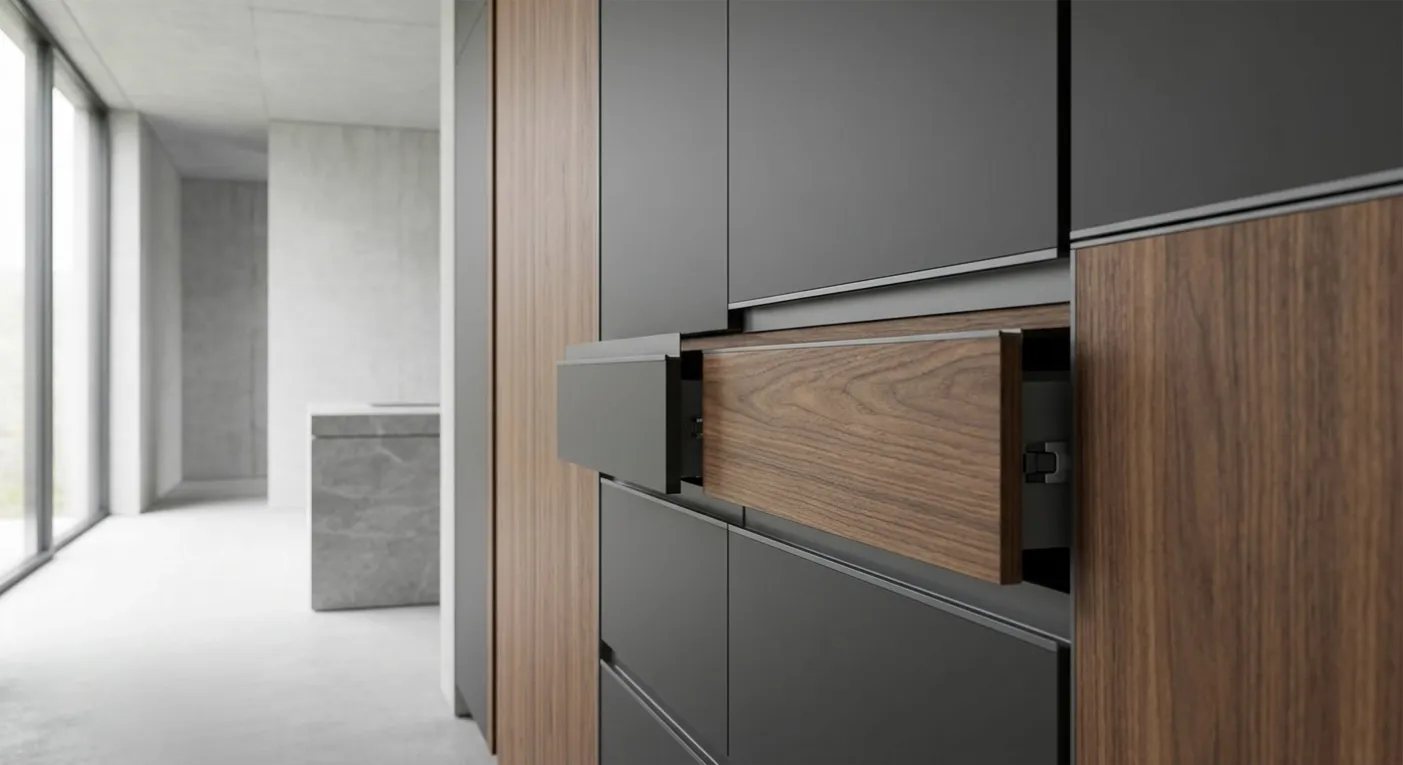
Modern interior architecture emphasizes tactile materiality—raw concrete, book-matched stone veneers, matte lacquers, and warm natural timber. When large-scale millwork and kitchen island cladding are designed to mimic monolithic stone blocks or seamless wood paneling, traditional surface-mounted handles disrupt the visual continuity.
Architects now approach cabinetry as an extension of the wall rather than standalone furniture. To maintain spatial purity, hardware must either:
- Recede entirely into the cabinetry architecture (flush/recessed profiles).
- Merge seamlessly into the material language (color-matched or edge-integrated extrusions).
- Disappear into invisible mechanical or magnetic mechanisms (push-to-open and touch-release systems).
2. Typologies of Near-Invisible Hardware Solutions
The near-invisible movement does not mean eliminating tactile interaction; rather, it elevates engineering precision. Here are the core hardware typologies driving modern minimalist projects:
A. Aluminum Gola Profiles (Recessed C-Channels & J-Channels)
Embedded directly into the cabinet carcass rather than the door front, Gola profile systems create continuous recessed channels. Users open doors by gripping the inner lip of the cabinet door, leaving the outer face entirely smooth and uninterrupted.
- Key Advantage: Creates clean horizontal or vertical shadow lines while maintaining ergonomic ease across wide drawer spans and integrated appliances.
B. Integrated Edge-Pull & Lip Profiles
Slim aluminum extruded pulls that mount along the top or side edges of cabinet doors with minimal overhang. When closed, only a ultra-thin 1.5mm to 2mm metal reveal is visible along the seam.
- Key Advantage: Provides a solid, positive tactile grip while preserving the flush elevation of the cabinetry wall.
C. Flush Recessed & Pocket Pulls
Machined into the face of timber or metal doors, flush pulls sit completely level with the door surface. Often finished in matching matte PVD or powder-coated tones, they provide structural depth without projecting into the living space.
D. Concealed Mechanical & Electro-Mechanical Touch Systems
For completely handleless facades, heavy-duty mechanical push-to-open latches and motorized servo-drive systems allow doors and deep drawers to spring open with a light tap.
3. Engineering Precision Behind Near-Invisible Hardware
Designing hardware that "disappears" actually requires significantly higher engineering tolerances than traditional surface-mounted pulls.
- Ultra-Precise Anodizing & Surface Uniformity: Because minimalist profiles rely on subtle light reflection and shadow lines, any imperfection in anodizing, brushed graining, or PVD coating becomes instantly visible.
- Tight Gap Tolerances (1.5mm to 2mm): Minimalist cabinetry relies on uniform reveal gaps across long runs. Hardware must be manufactured with zero warp to prevent bind or misalignment.
- Corrosion Resistance for Concealed Edges: Finger-grip channels collect ambient moisture and natural skin oils. Premium aluminum profiles require multi-stage sealing to prevent oxidation along hidden contact surfaces.
4. How YOUQI Hardware Empowers Minimalist Architectural Projects
At YOUQI Hardware, we work closely with architectural millwork companies, kitchen manufacturers, and hardware distributors to deliver cutting-edge concealed and profile hardware solutions:
- Custom Extrusions & Length Variations: We manufacture high-precision aluminum Gola profiles, J-pulls, and lip handles cut to precise architectural specifications with factory-finished end caps.
- Advanced Surface Color Matching: From deep architectural matte black and brushed bronze to custom anodized champagne gold, our finishes are engineered to harmonize with modern wood veneers, Fenix NTM, and sintered stone surfaces.
- Engineering Support for OEM/ODM Integration: Our DFM team helps furniture manufacturers integrate flush hardware channels directly into their CNC machining workflows, reducing assembly labor on-site.
Conclusion: The Future of Hardware Design
The near-invisible hardware movement is not a temporary trend—it is a permanent realignment with modern architectural principles. As residential and commercial spaces continue to prioritize clean lines, concealed storage, and material authenticity, hardware suppliers must evolve from decorative accessory makers into precision architectural partners.
By mastering integrated aluminum profiles, flush handle engineering, and seamless surface finishes, hardware buyers and manufacturers can deliver spaces that feel effortlessly sophisticated, quiet, and timeless.
Designing a modern minimalist furniture line or searching for precision integrated profile hardware? Contact the YOUQI Hardware engineering team to request sample kits and architectural CAD profiles.