Sep 5, 2026Buying Guides
Tariffs & Trade Compliance Guide for Importing YOUQI Hardware
A practical guide for international buyers importing YOUQI cabinet hardware, covering HS codes, shipping documents, country of origin, Incoterms, import duties and customs clearance.
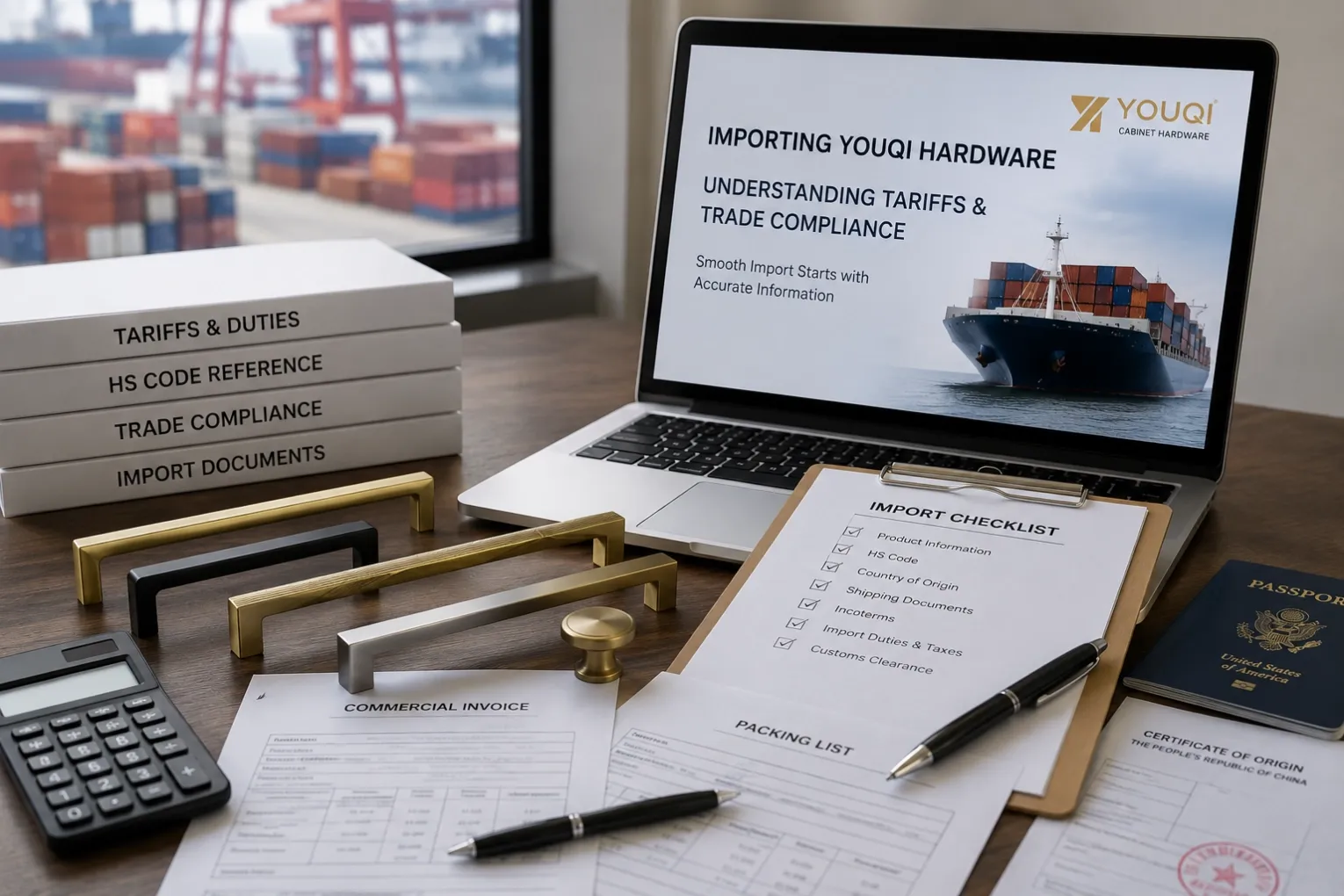
Understanding Tariffs and Trade Compliance: A Guide for Importing YOUQI Hardware
Importing cabinet hardware from China involves more than selecting the right products and agreeing on a price.
For international buyers, understanding tariffs, customs requirements, shipping documents and trade terms is an important part of planning a successful purchase.
Whether you are importing cabinet handles, pulls, cup pulls, knobs or hinges, having accurate product and shipping information can help make the import process more straightforward.
At YOUQI, we work with customers across Europe, South America, the Middle East, Southeast Asia and other international markets. We provide the necessary product and shipping information and cooperate with customers and their logistics partners throughout the order and shipping process.
This guide explains the main points buyers should consider when importing YOUQI hardware.
Key Takeaways
- Import duties and customs requirements depend on the destination country and the specific product.
- HS Codes should be confirmed according to the actual product being imported.
- YOUQI can provide the relevant HS Code according to the product.
- YOUQI products are manufactured in China and the country of origin is Made in China.
- Standard export documents include Commercial Invoice, Packing List and Bill of Lading.
- Certificate of Origin can also be provided when required.
- YOUQI works with EXW, FOB, CIF and DDP depending on the customer's requirements.
- Buyers should understand their own country's import duties and customs clearance requirements before placing an order.
- YOUQI can cooperate with customers, customs brokers and freight forwarders when additional product information is required.
What Are Tariffs and Import Duties?
A tariff is a charge imposed by a government on certain imported goods.
When cabinet hardware enters a destination country, the importer may be required to pay applicable import duties, taxes or other customs-related charges.
The actual amount depends on factors such as:
- Product classification
- HS Code
- Country of origin
- Customs value
- Destination country
- Applicable trade policies
- Specific product regulations
Because these requirements vary between countries and can change over time, buyers should confirm the applicable requirements with their local customs authority or customs broker.
For this reason, a cabinet hardware supplier should provide accurate product information, but the importer should also understand the requirements of the destination market.
What Is an HS Code?
An HS Code, or Harmonized System Code, is used to classify products for international trade.
Different products can have different classifications.
For cabinet hardware, the appropriate HS Code may depend on the actual product, material, construction and other classification factors.
At YOUQI, we can provide the HS Code according to the specific product being ordered.
However, buyers should not assume that one HS Code applies to every type of cabinet hardware.
The final classification and applicable tariff treatment should be confirmed according to the import regulations of the destination country.
Why Is the HS Code Important?
The HS Code can affect how imported goods are classified by customs and may be relevant when determining applicable duties and taxes.
For example, cabinet handles made from different materials or products with different constructions may require different classifications.
This is why it is important to provide the supplier with the exact product requirements and confirm the product classification before shipment.
For larger or recurring import programs, buyers can also work with their customs broker or import specialist to verify the appropriate classification for their market.
Country of Origin: Made in China
YOUQI cabinet hardware is manufactured in China.
Therefore, the country of origin of the products is:
Made in China
Country of origin is an important part of international trade documentation.
It may be relevant to customs declarations, tariff treatment, marking requirements and other import procedures depending on the destination market.
When customers require a Certificate of Origin, YOUQI can also provide it according to the order and documentation requirements.
What Export Documents Does YOUQI Provide?
Accurate shipping documents are an important part of the export and import process.
For standard shipments, YOUQI normally provides:
- Commercial Invoice
- Packing List
- Bill of Lading
If a customer requires a Certificate of Origin, we can also arrange and provide it.
These documents contain important information that can be used by the buyer, freight forwarder and customs broker during the shipping and customs process.
Commercial Invoice
The Commercial Invoice provides important information about the transaction.
For YOUQI orders, the document can include information such as:
- Product name
- Model number
- Quantity
- Unit price
- Total value
- Material
The invoice helps establish the commercial details of the shipment.
Buyers should make sure that the information on the Commercial Invoice is consistent with the actual order and other shipping documents.
Packing List
The Packing List provides information about how the products are packed and shipped.
It can include details such as:
- Carton quantity
- Carton dimensions
- Gross weight
- Net weight
- Total cartons
This information can be useful for freight arrangements, warehouse receiving and customs procedures.
Bill of Lading
For ocean shipments, the Bill of Lading is an important transport document.
It contains information related to the shipment and transportation of the goods.
The exact document details depend on the shipping arrangement and carrier.
Certificate of Origin
Some customers or destination markets may require a Certificate of Origin.
When required, YOUQI can provide a Certificate of Origin for the shipment.
Buyers should confirm whether this document is required for their particular import transaction before shipment.
Understanding Incoterms When Importing YOUQI Hardware
The responsibilities of the buyer and seller can vary depending on the agreed trade term.
YOUQI can work with customers using different Incoterms, including:
- EXW
- FOB
- CIF
- DDP
The selected term can affect responsibilities for transportation, customs clearance, costs and risk.
Therefore, buyers should understand exactly what is included in the agreed quotation before confirming an order.
EXW
Under EXW, the buyer generally takes responsibility for arranging transportation and handling the goods from the agreed location.
This option can be suitable for buyers who already have their own logistics arrangements.
However, buyers should understand all responsibilities and costs associated with the shipment before selecting this term.
FOB
FOB is commonly used for international ocean shipments.
Under an FOB arrangement, the supplier's responsibilities cover the agreed part of the shipment up to the specified point under the applicable Incoterms rules, while the buyer takes responsibility for the subsequent transportation and import process.
The exact responsibilities should always be confirmed in the quotation and sales contract.
CIF
Under CIF, the seller arranges the agreed ocean transportation and insurance to the named destination port, subject to the applicable Incoterms rules.
However, buyers should pay attention to the distinction between transportation arrangements and import clearance responsibilities.
Import duties and destination-country taxes are generally not automatically included simply because the quotation uses CIF.
DDP
DDP can provide a more comprehensive delivery arrangement because the seller takes on broader responsibilities under the applicable Incoterms rules, including import-related responsibilities in the destination country.
However, the feasibility of DDP depends on the destination country, local requirements and the specific shipping arrangement.
Therefore, buyers should confirm exactly what is included in the DDP quotation before placing the order.
Who Pays Import Duties and Customs Charges?
For standard international transactions, import duties, customs clearance charges and destination-country taxes are normally the responsibility of the buyer or importer unless otherwise agreed in the trade terms.
This is an important point to clarify before placing an order.
The product price and shipping cost do not necessarily represent the total landed cost.
Depending on the destination market, the importer may also need to consider:
- Import duties
- VAT or other taxes
- Customs clearance charges
- Broker fees
- Port charges
- Local delivery costs
- Other destination-related expenses
For this reason, buyers should calculate the expected landed cost rather than looking only at the factory price.
Why Buyers Should Check Import Requirements Before Ordering
One of the biggest challenges for new importers is not necessarily finding a supplier.
It can be understanding how to complete the import process after the goods leave China.
A buyer who is unfamiliar with customs procedures may face difficulties with:
- Product classification
- Customs declarations
- Import documentation
- Duty calculation
- Customs clearance
- Local delivery
Before placing a larger order, buyers should determine whether they have the necessary import capability or work with an experienced customs broker or freight forwarder.
What If You Do Not Have Import Clearance Experience?
This is particularly important for customers who are importing from China for the first time.
If you do not have experience with customs clearance in your country, consider working with a professional customs broker or freight forwarder.
They can help you understand:
- Required import documents
- HS Code requirements
- Customs declaration procedures
- Applicable duties and taxes
- Local customs requirements
- Delivery after customs clearance
YOUQI can cooperate with the customer's customs broker or freight forwarder and provide relevant product information whenever needed.
How YOUQI Supports Trade Compliance
Our role is not limited to manufacturing and supplying cabinet hardware.
We also understand that accurate communication and documentation are important parts of international B2B trade.
When customers or their logistics partners need information, YOUQI can cooperate and provide relevant details concerning:
- Product name
- Model number
- Material
- Quantity
- HS Code
- Country of Origin
- Commercial Invoice
- Packing List
- Shipping information
- Certificate of Origin when required
If a customer's customs broker or freight forwarder needs clarification, our team can communicate with them and provide the information available for the specific order.
A Practical Checklist Before Importing YOUQI Hardware
Before confirming an international cabinet hardware order, buyers should consider the following:
Item | What to Confirm |
|---|---|
Product | Exact product and model |
Material | Zinc alloy, aluminum, brass, stainless steel or other |
Quantity | Final order quantity |
HS Code | Confirm according to the specific product |
Country of Origin | Made in China |
Commercial Invoice | Product and transaction details |
Packing List | Cartons, dimensions and weights |
Certificate of Origin | Confirm whether required |
Incoterms | EXW, FOB, CIF or DDP |
Import Duties | Check destination-country requirements |
Customs Clearance | Confirm who will handle the process |
Freight Forwarder | Confirm shipping and import arrangements |
Preparing these details before shipment can help reduce misunderstandings and unexpected delays.
Common Trade Compliance Mistakes to Avoid
1. Assuming One HS Code Applies to Every Product
Different cabinet hardware products may require different classifications.
Always confirm the HS Code according to the actual product.
2. Looking Only at the Product Price
The factory price is not necessarily the final landed cost.
Import duties, taxes, customs charges and local logistics costs may also apply.
3. Ignoring the Country of Origin
Products supplied by YOUQI are manufactured in China, so buyers should take the applicable country-of-origin requirements into consideration.
4. Not Confirming the Incoterm
EXW, FOB, CIF and DDP can involve different responsibilities.
Make sure both sides understand what the agreed trade term covers.
5. Ordering Without Understanding Customs Clearance
If you are a first-time importer, make sure you know who will handle customs clearance before the goods are shipped.
Working with an experienced customs broker or freight forwarder can make the process easier.
How to Make Your First YOUQI Import Easier
For a new customer, the best approach is to confirm the important details before production begins.
A practical process is:
Product Selection → Quotation → Product Confirmation → Trade Term Confirmation → Order Confirmation → Production → Shipping Documents → Shipment → Customs Clearance → Delivery
At the beginning of the process, clearly confirm the product, quantity, material, finish, packaging and shipping requirements.
Before shipment, make sure the necessary documents and logistics arrangements are ready.
This gives both the supplier and buyer a clearer understanding of their responsibilities.
Why Accurate Product Information Matters
Trade compliance starts with accurate information.
A cabinet handle should not simply be described as "hardware" when more specific product information is required.
The buyer and supplier should have consistent information about:
- What the product is
- What it is made from
- How many units are being shipped
- The commercial value
- The country of origin
- The applicable product classification
Clear information can help the buyer and their customs broker handle the import process more efficiently.
YOUQI: A Cabinet Hardware Supplier for Global B2B Customers
YOUQI has around 10 years of experience in cabinet hardware and serves customers in Europe, South America, the Middle East, Southeast Asia and other international markets.
Our product range includes:
- Cabinet Handles
- Cabinet Pulls
- Cup Pulls
- Cabinet Knobs
- Cabinet Hinges
- Door Hinges
- Concealed Hinges
We support international customers with product sourcing, production, quality control, packaging and delivery.
For export orders, we can provide the relevant shipping and product documentation required for the specific shipment and cooperate with customers' logistics partners when additional information is needed.
Frequently Asked Questions
Does YOUQI provide HS Codes?
Yes. YOUQI can provide the HS Code according to the specific product. Buyers should also confirm the final applicable classification with their customs broker or the relevant authority in the destination country.
What is the country of origin of YOUQI hardware?
YOUQI hardware is manufactured in China, so the country of origin is Made in China.
What shipping documents does YOUQI normally provide?
Standard documents normally include the Commercial Invoice, Packing List and Bill of Lading. A Certificate of Origin can also be provided when required.
Which Incoterms does YOUQI support?
YOUQI can work with EXW, FOB, CIF and DDP depending on the customer's requirements and the specific shipment.
Does YOUQI help with customs clearance?
YOUQI can cooperate with the customer's customs broker or freight forwarder and provide relevant product and shipping information. The buyer should ensure that the necessary import arrangements are in place in the destination country.
Who is responsible for import duties?
For standard transactions, import duties, customs clearance charges and destination-country taxes are normally the responsibility of the buyer/importer unless otherwise agreed in the trade terms.
What if I have never imported cabinet hardware before?
If you are new to importing, it is recommended to work with an experienced customs broker or freight forwarder who understands the import requirements of your country.
Import with Greater Confidence
Importing cabinet hardware from China does not have to be complicated, but it does require preparation.
Understanding the HS Code, country of origin, shipping documents, Incoterms, import duties and customs clearance process can help buyers make better purchasing decisions and avoid unnecessary surprises.
At YOUQI, we provide the product and shipping information required for our international orders and remain available to communicate with customers, freight forwarders and customs brokers throughout the process.
If you are planning to import cabinet handles, pulls, knobs or hinges from China, contact YOUQI with your product requirements and destination market.
Ready to source cabinet hardware from China? Contact YOUQI to discuss your products, shipping terms and documentation requirements before placing your order.