Aug 20, 2026Buying Guides
Door Hinges vs Cabinet Hinges | Differences, Types & How to Choose
Understand the differences between door hinges and cabinet hinges, including materials, applications, soft-close options, finishes, customization and how to choose.
Door Hinges vs Cabinet Hinges: Differences, Types and How to Choose
Introduction
Hinges may look like a small component of a door or cabinet, but they play an important role in smooth movement, stability, durability and overall furniture performance.
For buyers sourcing hardware from China, one common question is:
What is the difference between door hinges and cabinet hinges?
Although both products connect a door or panel to a fixed structure, they are designed for different applications and can have significantly different structures, installation methods, materials and functions.
In this guide, we explain the main differences between door hinges and cabinet hinges, their common types, materials, finishes, applications and customization options, helping buyers select the right hinge for their project.
Door Hinges vs Cabinet Hinges: Quick Comparison
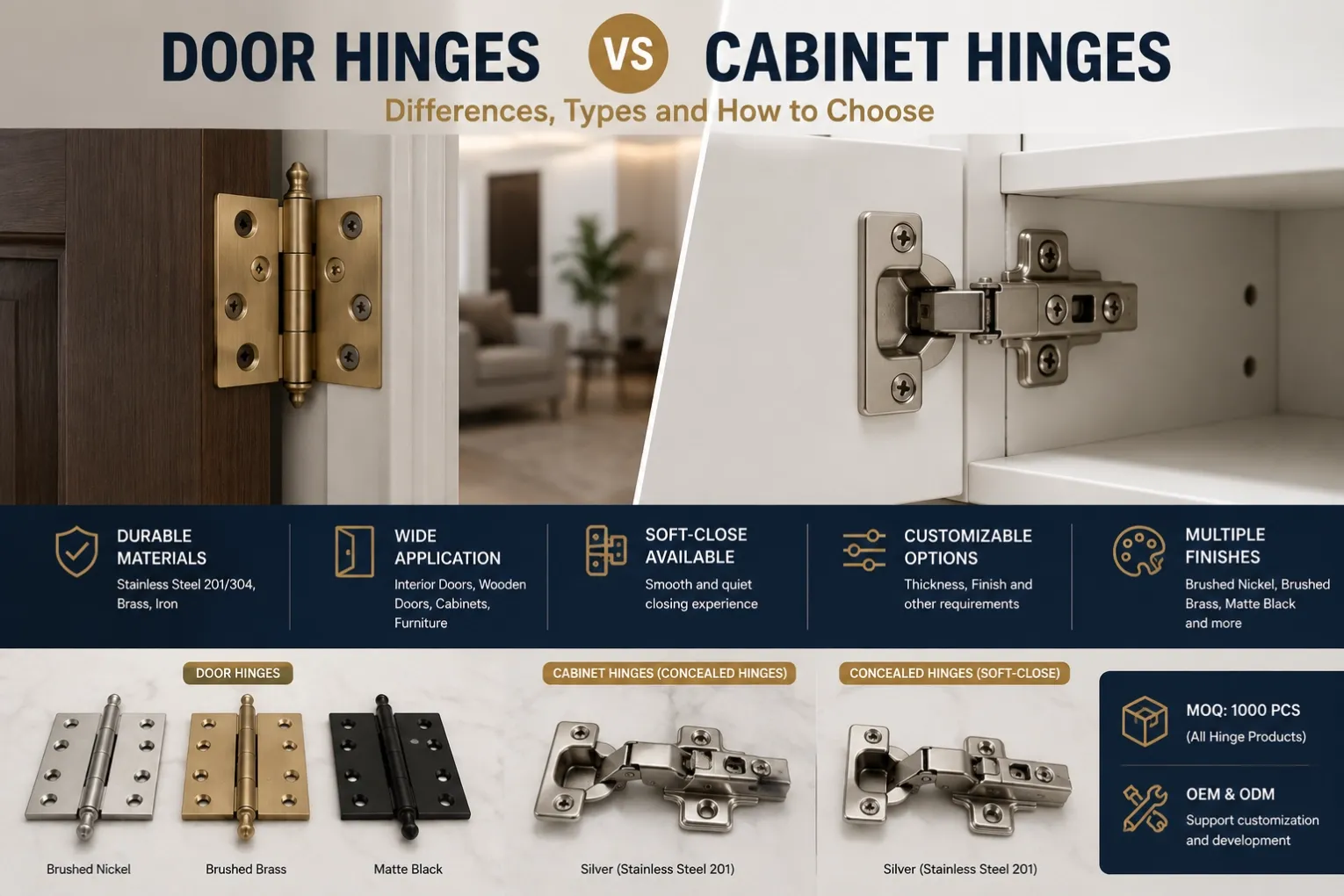
Feature | Door Hinges | Cabinet Hinges |
|---|---|---|
Main Application | Interior and wooden doors | Cabinets and furniture |
Common Materials | Brass, Stainless Steel 201, Stainless Steel 304, Iron | Mainly Stainless Steel 201 |
Installation | Usually visible or semi-visible | Commonly concealed |
Soft-Close | Available for selected designs | Available |
Common Finishes | Brushed Nickel, Brushed Brass, Matte Black and more | Mainly Silver |
Customization | Thickness, finish and other requirements | Thickness, finish and other requirements |
Typical Use | Interior Doors, Wooden Doors | Kitchen Cabinets, Wardrobes, Cupboards and Furniture |
MOQ | Generally 1,000 pcs | Generally 1,000 pcs |
The most important difference is simple:
Door hinges are primarily designed for doors, while cabinet hinges are designed specifically for cabinet and furniture doors.
However, choosing the right hinge requires looking beyond the basic application.
What Are Door Hinges?
Door hinges are hardware components used to connect a door to its frame and allow the door to open and close.
They are commonly used for:
- Interior doors
- Wooden doors
- Residential furniture-related doors
- Other suitable door applications
Door hinges generally need to support the weight and movement of a larger door panel.
Depending on the design and project requirements, door hinges can be produced using different materials and finishes.
Door Hinge Materials
Different materials can be selected according to the required performance, appearance and budget.
Common materials include:
Brass
Brass is widely appreciated for its attractive appearance and substantial feel.
It is also suitable for decorative door hardware where the finish is an important part of the overall interior design.
Stainless Steel 201
Stainless Steel 201 can provide a practical combination of strength, appearance and cost efficiency for selected door hinge applications.
Stainless Steel 304
Stainless Steel 304 is another option for projects requiring a higher level of corrosion resistance and material performance.
Iron
Iron can also be used for selected door hinge designs where structural requirements and cost considerations make it appropriate.
Common Door Hinge Finishes
Door hinges are available in several popular finishes.
Common choices include:
- Brushed Nickel
- Brushed Brass
- Matte Black
- Custom Colors
These finishes allow door hardware to coordinate with handles, locks and other interior hardware.
Matte Black is particularly suitable for modern interiors, while brushed nickel and brushed brass can create different visual effects depending on the door and interior design.
Other colors can also be customized according to project requirements.
What Are Cabinet Hinges?
Cabinet hinges are specifically designed for cabinet and furniture doors.
They are commonly used for:
- Kitchen cabinets
- Wardrobes
- Cupboards
- Furniture doors
- Storage cabinets
- Bathroom vanities
- Other furniture applications
Unlike many traditional door hinges, cabinet hinges are commonly designed to be concealed when the cabinet door is closed.
This creates a cleaner appearance and allows the hinge to integrate into the cabinet structure.
Cabinet Hinge Materials
At YOUQI, cabinet hinges are mainly manufactured using Stainless Steel 201.
Stainless steel provides a practical material solution for cabinet hinge applications where durability and reliable everyday operation are important.
The appropriate material should always be selected according to the cabinet structure, environment, usage requirements and project budget.
Concealed Cabinet Hinges
Concealed hinges are widely used in modern cabinet construction.
When the cabinet door is closed, most of the hinge structure is hidden inside the cabinet and behind the door.
This provides several advantages:
- Clean appearance
- Minimal visible hardware
- Modern furniture aesthetics
- Practical cabinet installation
- Suitable for many kitchen and wardrobe designs
Concealed hinges are especially common in contemporary furniture because they allow the cabinet design to remain visually clean.
Soft-Close Hinges
Soft-close functionality has become increasingly popular in modern furniture hardware.
A soft-close hinge helps slow the cabinet door during the final stage of closing.
This can provide:
- Smoother closing
- Reduced impact
- Less closing noise
- Better user experience
- A more refined furniture experience
Soft-close hinges are available for suitable cabinet hinge designs.
For projects where quiet and controlled cabinet operation is important, soft-close functionality can be an important specification to consider.
Main Differences Between Door Hinges and Cabinet Hinges
1. Different Applications
The most obvious difference is application.
Door hinges are primarily designed for:
- Interior doors
- Wooden doors
Cabinet hinges are primarily designed for:
- Kitchen cabinets
- Wardrobes
- Cupboards
- Furniture doors
Using the correct hinge for the intended application is important for proper installation and long-term performance.
2. Different Structures
Door hinges and cabinet hinges have different structural designs because the doors they support have different requirements.
Traditional door hinges are generally mounted between the door and frame.
Cabinet hinges are often designed as concealed mechanisms that connect the cabinet door to the cabinet body.
This difference affects installation, adjustment and appearance.
3. Different Visual Requirements
Door hardware can be intentionally visible because the hinge may form part of the overall door hardware design.
Cabinet hinges, on the other hand, are usually hidden when the cabinet is closed.
For modern kitchens and wardrobes, concealed cabinet hinges help maintain a clean and minimalist appearance.
4. Different Material Requirements
Door hinges may use several materials depending on the application, including:
- Brass
- Stainless Steel 201
- Stainless Steel 304
- Iron
Cabinet hinges are mainly made from Stainless Steel 201 in the YOUQI range.
Material selection should consider the application, required strength, corrosion resistance, appearance and cost.
How to Choose the Right Hinge
Choosing the right hinge starts with understanding the application.
Step 1: Identify the Application
First determine whether the product is intended for:
- An interior door
- A wooden door
- A kitchen cabinet
- A wardrobe
- Another furniture door
This immediately narrows down the appropriate hinge category.
Step 2: Consider the Door or Panel
The size, weight and thickness of the door or panel can influence the required hinge.
Buyers should provide accurate door or cabinet specifications to the supplier before confirming the product.
Step 3: Decide Whether Soft-Close Is Required
For cabinet projects, consider whether soft-close functionality is required.
If the furniture is positioned as a premium or high-end product, soft-close hinges can provide a more refined user experience.
Step 4: Select the Material
Material should be selected according to the application and project requirements.
For door hinges, available materials may include brass, Stainless Steel 201, Stainless Steel 304 and iron.
For cabinet hinges, Stainless Steel 201 is a common option.
Step 5: Select the Finish
For visible door hinges, finish can have a significant influence on the overall appearance.
Popular door hinge finishes include:
- Brushed Nickel
- Brushed Brass
- Matte Black
Custom colors can also be developed for specific projects.
For cabinet hinges, silver is a common finish.
Step 6: Confirm Dimensions and Thickness
Dimensions and thickness are important specifications that should be confirmed before production.
Customized thickness and other specifications can be discussed according to project requirements.
Can Hinges Be Customized?
Yes.
Depending on the product, hinge customization may include:
- Thickness
- Finish
- Color
- Product structure
- Other project-specific requirements
For OEM and ODM projects, buyers should provide drawings, samples or detailed product requirements whenever possible.
The supplier can then evaluate the product structure and recommend a suitable production solution.
Door Hinge vs Cabinet Hinge: Which One Should You Choose?
There is no universal answer.
The correct choice depends primarily on the application.
Choose Door Hinges When:
- You are installing interior doors
- You are working with wooden doors
- Visible door hardware is acceptable or preferred
- You require different material options
- Finish coordination is important
Choose Cabinet Hinges When:
- You are manufacturing kitchen cabinets
- You are producing wardrobes
- You need concealed cabinet hardware
- You require soft-close functionality
- You want a clean furniture appearance
The key is to match the hinge structure with the actual door or furniture application.
What Should B2B Buyers Ask a Hinge Supplier?
Before placing a bulk order, buyers should confirm several important specifications.
Product Questions
- What type of hinge is suitable for my application?
- What materials are available?
- What sizes and thicknesses are available?
- Is soft-close available?
- What finishes are available?
Customization Questions
- Can the thickness be customized?
- Can the finish be customized?
- Can colors be customized?
- Can the product structure be customized?
Quality Questions
- How is the material inspected?
- How are dimensions checked?
- How is the surface finish inspected?
- Is every production batch inspected?
- How is final quality controlled?
Order Questions
- What is the MOQ?
- What is the production lead time?
- Can samples be provided?
- Can packaging be customized?
- How will production progress be communicated?
MOQ for Hinge Products
For YOUQI hinge products, the general MOQ is:
1,000 pieces for both standard and customized hinge products.
The actual production arrangement can still depend on the product specification and customization requirements.
For B2B buyers, confirming MOQ at the quotation stage helps with inventory planning and project budgeting.
Why Choose YOUQI for Cabinet and Door Hinges?
YOUQI provides cabinet and door hardware solutions for international furniture and interior projects.
Our hinge range includes:
- Cabinet Hinges
- Door Hinges
- Concealed Hinges
Door hinges can be produced using materials including:
- Brass
- Stainless Steel 201
- Stainless Steel 304
- Iron
Cabinet hinges are mainly available in Stainless Steel 201.
We also provide different finish options according to the product category, including brushed nickel, brushed brass, matte black and silver, while customized finishes can be discussed for specific projects.
OEM & ODM Support
YOUQI supports customized requirements including:
- Thickness
- Finish
- Color
- Product requirements
- Customized packaging
Customers can communicate their specifications and project requirements with our team so that the appropriate hinge solution can be evaluated.
Quality and Service
Product quality and professional service are important parts of our approach to cabinet and furniture hardware.
For B2B projects, we focus not only on supplying products but also on maintaining clear communication throughout the order process.
Frequently Asked Questions
What is the main difference between door hinges and cabinet hinges?
Door hinges are mainly designed for interior and wooden doors, while cabinet hinges are specifically designed for cabinets and furniture doors. Cabinet hinges are commonly concealed when the cabinet door is closed.
Are cabinet hinges usually concealed?
Yes. Concealed hinges are widely used in modern cabinet and furniture applications because the hinge mechanism is largely hidden when the cabinet door is closed.
Are soft-close hinges available?
Yes. Soft-close functionality is available for suitable cabinet hinge designs and can provide smoother and quieter cabinet door closing.
What materials are available for door hinges?
Common materials include brass, Stainless Steel 201, Stainless Steel 304 and iron.
What material are YOUQI cabinet hinges made from?
YOUQI cabinet hinges are mainly manufactured using Stainless Steel 201.
What colors are available for door hinges?
Common finishes include brushed nickel, brushed brass and matte black. Other colors can also be customized according to project requirements.
What is the MOQ for YOUQI hinges?
The general MOQ is 1,000 pieces for both standard and customized hinge products.
Can hinge thickness and finish be customized?
Yes. Thickness and finish can be customized according to the product and project requirements.
Conclusion
Door hinges and cabinet hinges may serve a similar basic function, but they are designed for different applications and installation requirements.
Door hinges are mainly used for interior and wooden doors and can be produced in materials such as brass, Stainless Steel 201, Stainless Steel 304 and iron.
Cabinet hinges are designed specifically for cabinets and furniture, with concealed hinges and soft-close options providing a clean appearance and improved user experience.
When selecting hinges, buyers should consider the application, door or panel specifications, material, thickness, finish, soft-close requirements, customization, MOQ and quality control.
For furniture manufacturers, distributors, brands and project buyers, choosing the right hinge supplier can help ensure consistent product quality and reliable project execution.
YOUQI provides cabinet hinges, door hinges and concealed hinges with multiple material and finish options, customization support, OEM/ODM capabilities and professional service for international customers.