Aug 21, 2026Buying Guides
Cabinet Hardware Quality Control | How We Ensure Consistent Quality
Discover how cabinet hardware quality is controlled through material inspection, production checks, dimensional testing, surface inspection, hinge testing, final QC and packaging.
Cabinet Hardware Quality Control: How to Ensure Consistent Product Quality
Introduction
When purchasing cabinet hardware in bulk, product appearance is only one part of quality.
For furniture manufacturers, distributors, brands and project buyers, consistent dimensions, reliable surface finishes, accurate installation points and stable product performance are equally important.
A cabinet handle with incorrect hole spacing may not fit the customer's cabinet. A poor surface finish can affect the appearance of an entire furniture collection. A hinge with inconsistent opening performance can affect the everyday use of a cabinet or door.
This is why a professional cabinet hardware supplier needs a quality control process that covers the entire production cycle.
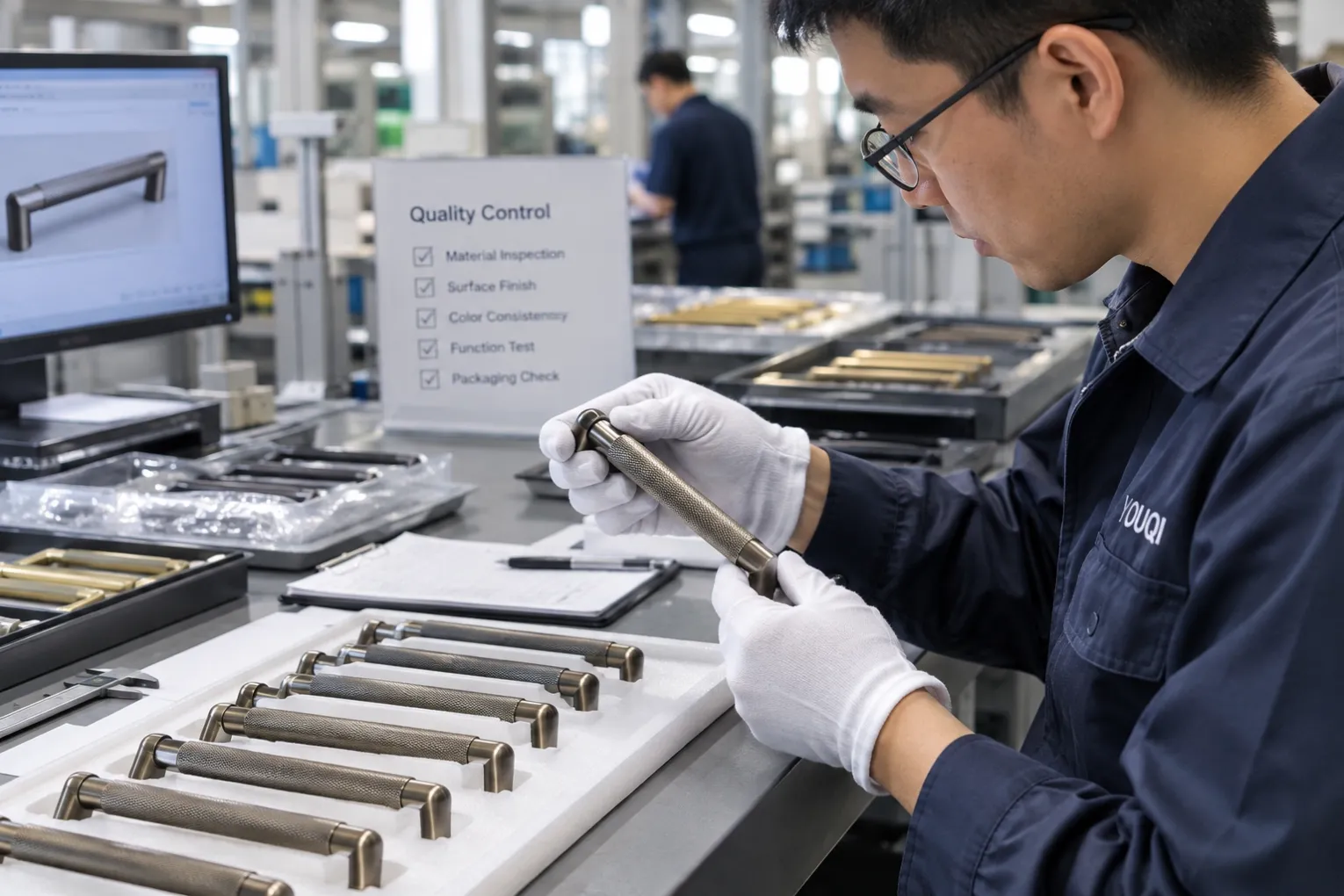
At YOUQI, quality control covers the process from incoming materials to final packing, with different inspection methods applied according to the characteristics of each product.
Key Takeaways
- Quality control should begin with incoming materials, not only at the end of production.
- Cabinet handles require accurate dimensional and installation checks.
- Hinges require functional and durability testing in addition to appearance inspection.
- Surface finishes need to be checked for consistency and visible defects.
- YOUQI uses random final inspection based on order quantity, with a 5% sampling rate.
- Defective products identified during inspection are scrapped.
- Customer-approved samples are used as an important reference before mass production.
- Production progress is communicated with customers during the manufacturing process.
Why Is Quality Control Important for Cabinet Hardware?
Cabinet hardware is usually purchased in relatively large quantities.
If a small defect exists in a batch of 500 or 1,000 pieces, the problem can quickly become a significant issue for the buyer.
Poor quality control may result in:
- Installation problems
- Incorrect hole spacing
- Inconsistent product dimensions
- Surface defects
- Color differences
- Poor hinge operation
- Premature product failure
- Packaging damage
- Customer complaints
- Additional replacement costs
For this reason, B2B buyers should evaluate not only the product itself but also how the supplier controls the product during manufacturing.
What Does Cabinet Hardware Quality Control Include?
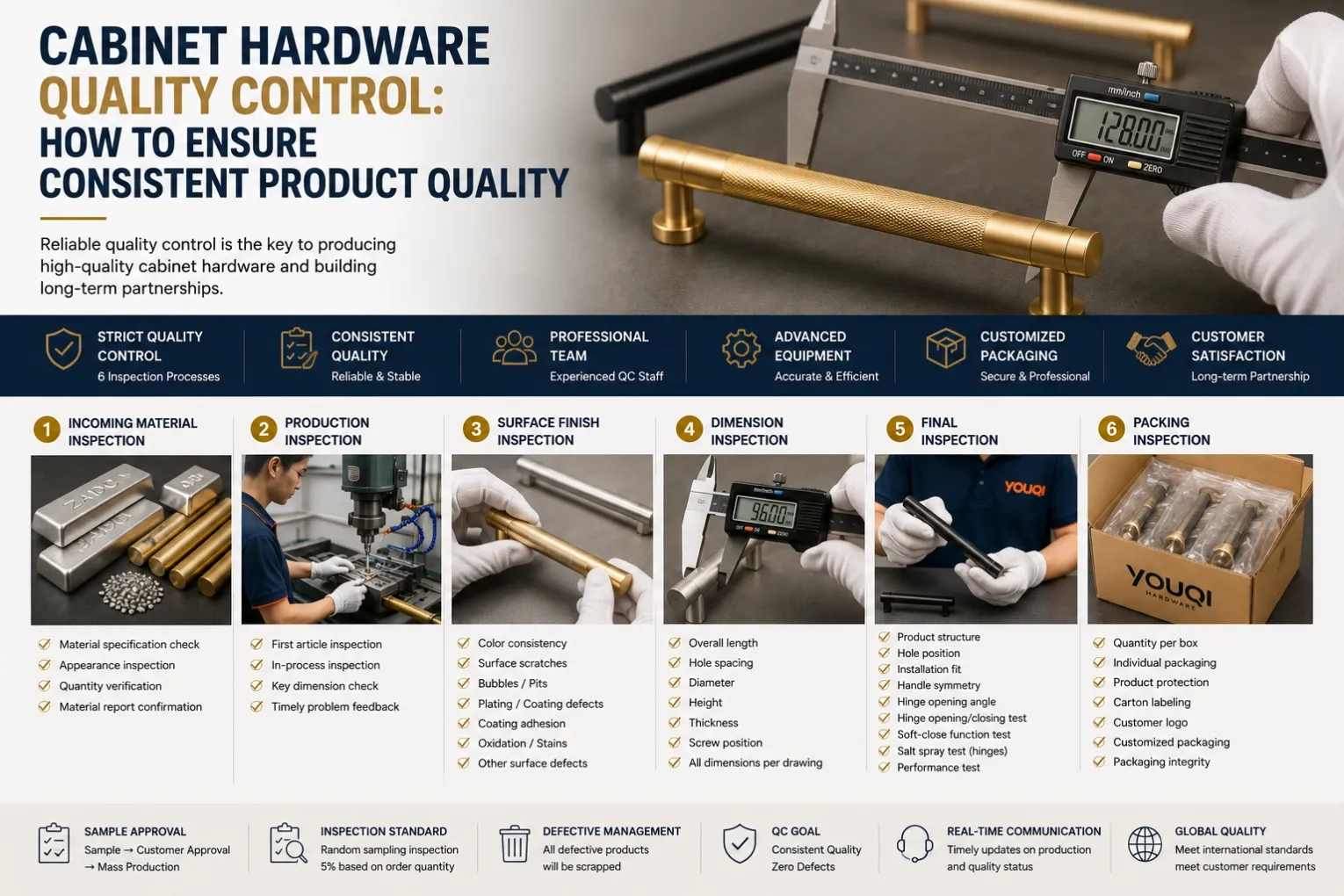
A complete quality control process can be divided into six main stages:
- Incoming Material Inspection
- Production Inspection
- Surface Finish Inspection
- Dimension Inspection
- Final Inspection
- Packing Inspection
These stages work together to reduce quality risks throughout the production process.
1. Incoming Material Inspection
Quality control begins before the product enters production.
When raw materials and components arrive, they need to be checked against the production requirements.
Depending on the product, incoming inspection can cover:
- Material specification
- Material appearance
- Material quantity
- Basic dimensions
- Visible defects
- Production requirements
YOUQI works with different cabinet hardware materials, including zinc alloy, aluminum, brass and stainless steel depending on the product.
For hinge products, different materials may also be used according to the product design and application.
Checking materials before production helps prevent unsuitable materials from entering the manufacturing process.
2. Production Inspection
The next stage is inspection during production.
Instead of waiting until the products are finished, quality needs to be monitored during the manufacturing process.
Production inspection can focus on:
- Product structure
- Dimensions
- Installation points
- Surface condition
- Production consistency
- Functional requirements
For customized products, the approved drawing or sample becomes especially important.
This is because customized products may have specific dimensions, structures or finishing requirements that differ from standard products.
3. Surface Finish Inspection
Surface finish is one of the most visible aspects of cabinet hardware.
Even when the product structure is correct, an inconsistent finish can affect the overall appearance of the furniture.
Surface inspection can include checking for:
- Color consistency
- Scratches
- Bubbles
- Uneven finish
- Plating defects
- Coating adhesion
- Oxidation
- Other visible surface problems
This is particularly important for finishes such as:
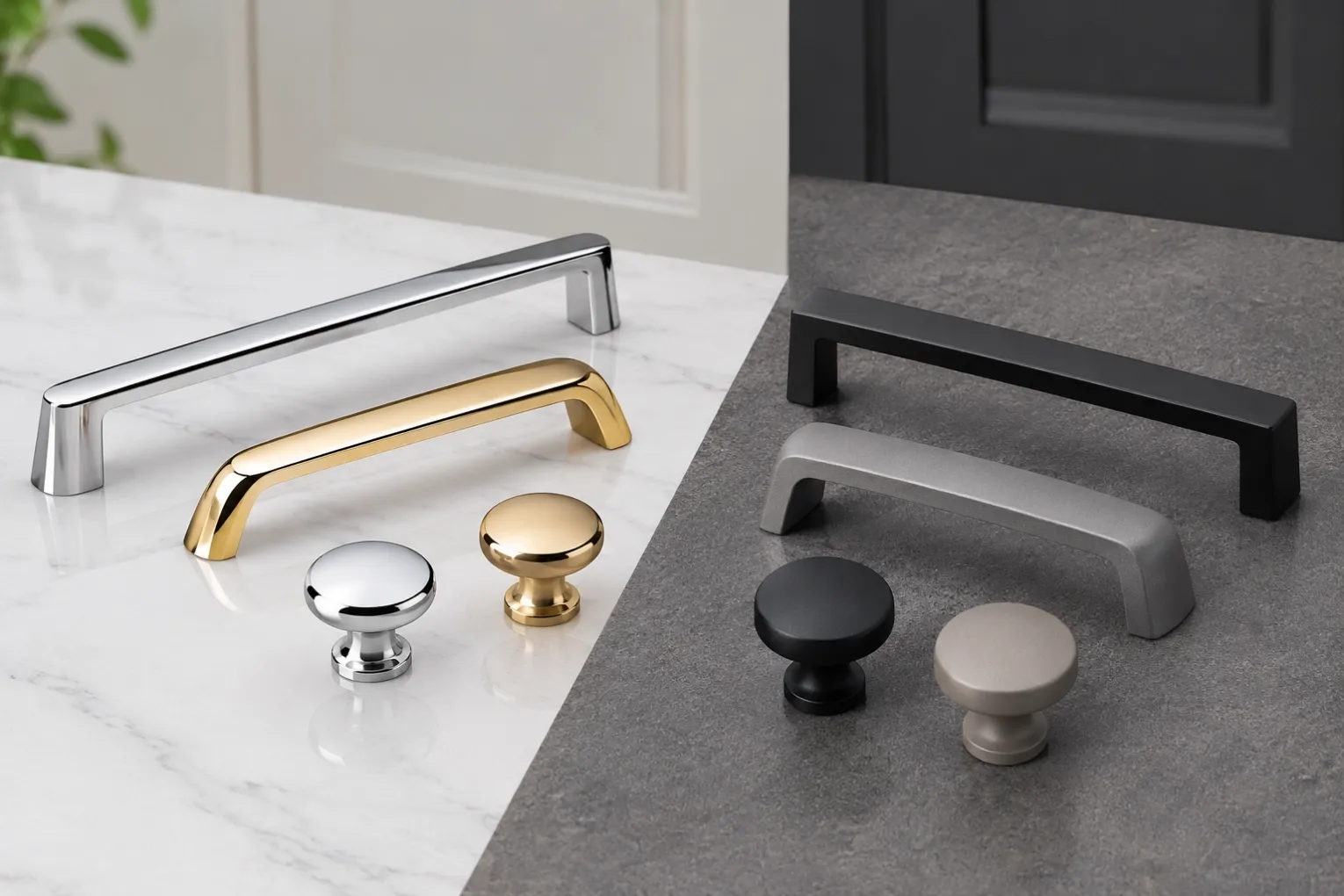
- Matte Black
- Brushed Gold
- Satin Nickel
- Chrome
- Antique Bronze
- PVD
- Black Nickel
For customized colors, the approved sample or agreed color standard should be used as a reference.
4. Dimension Inspection
Accurate dimensions are essential for cabinet hardware.
A product can look perfect but still create installation problems if the dimensions are incorrect.
Depending on the product, dimensional inspection can include:
- Overall length
- Hole spacing
- Diameter
- Height
- Thickness
- Screw position
- Other specified dimensions
Cabinet Handle Hole Spacing
For cabinet handles, hole spacing is particularly important.
The distance between the mounting holes must match the required specification so that the handle can be installed correctly.
For standard products, the agreed dimensions should be maintained consistently during production.
For customized handles, the customer's drawing, specifications or approved sample should be used as the reference.
Why Dimension Consistency Matters
Imagine a customer ordering hundreds or thousands of cabinet handles for one furniture collection.
If the hole spacing varies between products, installation becomes difficult and may require additional adjustment or replacement.
Consistent dimensional control therefore directly affects the buyer's production efficiency.
5. Product Structure and Functional Inspection
Not every quality problem can be identified through visual inspection.
Different cabinet hardware products require different functional checks.
Cabinet Handles
For cabinet handles and pulls, inspection can include:
- Hole spacing
- Overall dimensions
- Screw position
- Handle symmetry
- Product structure
- Installation fit
- Surface finish
The product should maintain a complete and symmetrical structure and be suitable for practical installation.
Cabinet Hinges
Hinges require additional functional testing because they contain moving components.
Depending on the hinge, inspection can include:
- Opening angle
- Opening and closing performance
- Repeated opening and closing
- Structural stability
- Installation fit
- Soft-close performance
This type of product-specific testing is important because a hinge can have an acceptable appearance while still having a functional problem.
6. Hinge Durability Testing
Hinges are repeatedly operated during everyday use, so durability is an important consideration.
For suitable hinge products, testing can include repeated opening and closing cycles.
This helps evaluate whether the hinge can maintain its expected operation during repeated use.
Other tests may also be used according to the product and customer requirements.
Salt Spray Testing
For suitable metal hinge products and finishes, salt spray testing can be used to evaluate corrosion resistance.
This is particularly relevant when surface durability and corrosion resistance are important project requirements.
The exact testing requirements should be determined according to the product material, surface treatment and customer's specifications.
7. Final Inspection
After production is completed, the finished products undergo final inspection before packing.
At YOUQI, final inspection uses random sampling based on order quantity, with a 5% inspection rate.
The final inspection can cover:
- Product appearance
- Dimensions
- Product structure
- Installation fit
- Surface finish
- Functional performance
- Packaging requirements
This provides a final quality checkpoint before products move to the packing stage.
What Happens When Defective Products Are Found?
Quality control is not only about finding defects.
How a supplier handles defective products is equally important.
At YOUQI, defective products identified during inspection are scrapped.
They are not mixed with qualified products for shipment.
This approach helps prevent products that fail inspection from entering the customer's order.
For B2B buyers, strict defect handling can reduce the risk of receiving inconsistent products and facing additional problems after delivery.
8. Packing Inspection
Product quality does not end when manufacturing is completed.
Packaging also needs to be checked before shipment.
Packing inspection can include:
- Product quantity
- Individual packaging
- Product protection
- Carton labeling
- Customer logo
- Customized labels
- Customized carton design
- Overall packaging condition
This is particularly important for international shipments because cabinet hardware may experience multiple stages of transportation and handling.
Proper packaging helps reduce the risk of scratches, impact damage and missing components during transportation.
Quality Control for Different Cabinet Hardware Products
Different hardware products have different quality priorities.
Cabinet Handles
Key inspection points include:
- Hole spacing
- Overall length
- Diameter
- Height
- Thickness
- Screw position
- Symmetry
- Installation fit
- Surface finish
Cup Pulls
Cup pulls can be checked for:
- Overall dimensions
- Mounting hole position
- Structural integrity
- Installation fit
- Surface finish
- Appearance consistency
Cabinet Hinges
Cabinet hinges require particular attention to:
- Opening angle
- Opening and closing performance
- Repeated operation
- Soft-close function where applicable
- Installation fit
- Surface finish
- Corrosion resistance where required
Door Hinges
Depending on the design, door hinges can be inspected for:
- Material
- Thickness
- Dimensions
- Opening and closing performance
- Structural stability
- Surface finish
- Corrosion resistance
The inspection process should therefore be adapted to the actual product instead of using exactly the same checklist for every type of hardware.
Sample Approval Before Mass Production
For customized cabinet hardware, sample approval is an important quality control step.
A typical workflow is:
Sample → Customer Approval → Mass Production → QC Inspection → Packing → Shipment
Before mass production, customers can review the sample and confirm:
- Product design
- Dimensions
- Finish
- Color
- Structure
- Installation requirements
- Overall quality
Once the sample is approved, it provides a clear reference for mass production.
This is particularly important for OEM and ODM projects because customized products may contain specifications that are different from standard products.
How Buyers Can Evaluate a Supplier's Quality Control
When choosing a cabinet hardware supplier, buyers should ask more than:
"Is your quality good?"
A better approach is to ask specific questions about the supplier's QC system.
Ask About Materials
- How are incoming materials inspected?
- Are material specifications checked?
- How are unsuitable materials handled?
Ask About Dimensions
- How is hole spacing checked?
- How are overall dimensions measured?
- How are customized dimensions controlled?
Ask About Surface Finish
- How is color consistency checked?
- How are scratches and plating defects identified?
- How are customized finishes controlled?
Ask About Hinges
- Is the opening angle tested?
- Are opening and closing cycles tested?
- Is soft-close performance tested?
- Is salt spray testing available when required?
Ask About Final Inspection
- Is the inspection 100% or sampling?
- What is the sampling rate?
- What happens to defective products?
A supplier that can provide clear answers to these questions gives buyers a better understanding of its actual quality control capabilities.
Cabinet Hardware Quality Control Checklist for Buyers
Quality Area | What Buyers Should Check |
|---|---|
Materials | Material specification, appearance and quantity |
Production | Manufacturing consistency and product structure |
Dimensions | Length, hole spacing, diameter, height and thickness |
Surface Finish | Color, scratches, bubbles, plating and coating |
Installation | Screw position and installation fit |
Handles | Hole spacing, symmetry and structure |
Hinges | Opening angle, operation and durability |
Functional Testing | Opening/closing and soft-close performance |
Salt Spray | Corrosion resistance where required |
Final Inspection | Inspection method and sampling rate |
Defect Handling | Procedure for rejected products |
Packaging | Quantity, protection, labels and carton requirements |
Why Choose YOUQI for Cabinet Hardware?
YOUQI combines factory resources with supply chain integration and focuses on consistent quality, reliable production and professional service.
Our quality control process covers the complete production cycle:
Incoming Material Inspection → Production Inspection → Surface Finish Inspection → Dimension Inspection → Final Inspection → Packing Inspection
Product-Specific Quality Control
Different products receive different inspection priorities.
For cabinet handles, we pay particular attention to dimensions, hole spacing, structure, symmetry and installation fit.
For hinges, we focus on opening and closing performance, opening angle, repeated operation testing and, where required, salt spray testing.
Customer Sample Approval
For customized products, customers can review and approve samples before mass production.
This gives both sides a clear reference for the final product.
Strict Defect Handling
Products identified as defective during inspection are scrapped rather than mixed with qualified products.
Production Communication
Production progress is communicated with customers during the manufacturing process.
This helps buyers stay informed about their order status and coordinate production, inventory and logistics more effectively.
Frequently Asked Questions
How does quality control affect cabinet hardware?
Quality control helps ensure that cabinet hardware maintains consistent dimensions, appearance, structure and functional performance throughout production.
What is checked on a cabinet handle?
Important checks include hole spacing, overall dimensions, screw position, symmetry, installation fit, structure and surface finish.
How are cabinet hinges tested?
Depending on the product, hinge testing can include opening angle checks, repeated opening and closing tests, soft-close testing and salt spray testing.
Does YOUQI inspect every finished product?
YOUQI uses random sampling for final inspection based on order quantity, with a 5% inspection rate.
What happens to defective products?
Defective products identified during inspection are scrapped and are not mixed with qualified products.
Can customers approve samples before mass production?
Yes. Customers can review and approve samples before mass production, providing a clear reference for production.
Can quality requirements be customized?
Yes. Inspection and quality requirements can be discussed according to product specifications, drawings, approved samples and specific project requirements.
Conclusion
Reliable cabinet hardware quality comes from a complete quality control system rather than a single final inspection.
From incoming materials and production inspection to dimensions, surface finishes, functional testing, final inspection and packaging, every stage can affect the quality of the finished product.
For cabinet handles, accurate hole spacing, dimensions, symmetry and installation fit are essential.
For hinges, opening and closing performance, durability, soft-close functionality and corrosion resistance may also require additional testing.
For B2B buyers, understanding a supplier's actual QC process is therefore an important part of supplier evaluation.
At YOUQI, quality control is integrated into the production process, supported by customer sample approval, product-specific testing, strict defect handling and continuous production communication.
Consistent quality is not simply a final inspection result. It is the result of controlling the details throughout the entire manufacturing process.