Aug 15, 2026Buying Guides
Cabinet Hardware Manufacturing Process | From Design to Finished Product
Learn how cabinet hardware is manufactured, from product design and material selection to precision machining, surface finishing, quality inspection, and packaging.
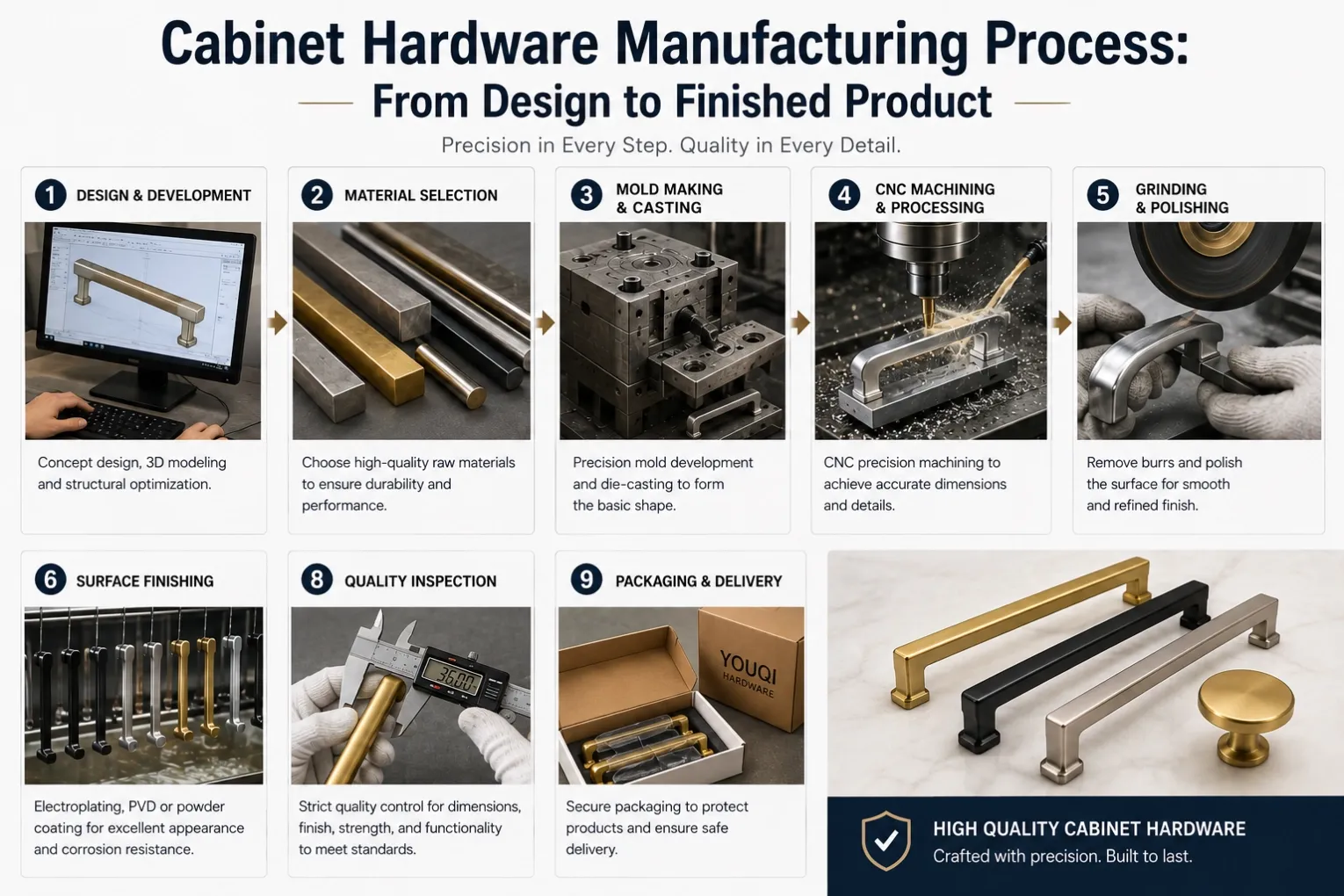
Cabinet Hardware Manufacturing Process: From Design to Finished Product
Introduction
Cabinet hardware may be small in size, but every detail matters. A well-designed cabinet handle, pull, hinge, or cup pull combines functional performance, precise manufacturing, durable materials, and refined surface finishing.
At YOUQI Hardware, we understand that high-quality cabinet hardware starts long before the finished product leaves the factory. From design development and material selection to machining, polishing, finishing, assembly, and inspection, every stage contributes to the final quality of the product.
This article explains the complete cabinet hardware manufacturing process and how a professional manufacturer turns an initial design concept into a finished product.
1. Product Design and Development
The manufacturing process begins with product design.
Based on customer requirements, market trends, application scenarios, and design concepts, engineers develop the initial product structure and appearance. Important factors such as dimensions, mounting methods, ergonomics, material selection, and production feasibility are considered at this stage.
For custom cabinet hardware, CAD drawings and 3D models are commonly used to confirm:
- Product dimensions
- Hole spacing and mounting specifications
- Structural design
- Material requirements
- Surface finish
- Installation method
- Production feasibility
A well-developed design helps reduce manufacturing problems and ensures that the final product meets both aesthetic and functional requirements.
2. Material Selection
Material selection has a direct impact on the durability, appearance, and performance of cabinet hardware.
Depending on the product design and application, common materials include:
- Zinc alloy
- Stainless steel
- Aluminum
- Brass
- Iron and other metal materials
Different materials offer different advantages. For example, stainless steel provides excellent corrosion resistance, while zinc alloy allows manufacturers to create complex shapes with high design flexibility.
At this stage, material specifications and quality requirements are confirmed before production begins.
3. Mold Making and Casting
For die-cast cabinet hardware, a precision mold is created according to the approved product design.
The mold determines the basic shape and structural details of the product. High-quality molds are essential for maintaining dimensional consistency during mass production.
Molten metal is then injected into the mold under controlled conditions to form the basic product shape.
After casting, each piece undergoes preliminary inspection to identify issues such as:
- Porosity
- Cracks
- Deformation
- Incomplete filling
- Surface defects
Products that do not meet the required standards are removed before entering the next production stage.
4. CNC Machining and Precision Processing
Some cabinet hardware requires additional machining after casting or forming.
CNC machining can be used to achieve accurate dimensions and improve critical areas of the product. Depending on the design, machining may include drilling, tapping, cutting, milling, or other precision operations.
This stage is particularly important for installation holes and connection points because dimensional accuracy directly affects the installation experience.
5. Grinding and Polishing
After machining, the product surface is processed to remove burrs, casting marks, sharp edges, and other imperfections.
Grinding creates a smooth and consistent surface, while polishing can further improve the appearance of the hardware.
The level of polishing depends on the desired final finish. Products designed for premium applications may require multiple polishing stages to achieve a refined and uniform appearance.
6. Surface Finishing
Surface finishing is one of the most important stages in cabinet hardware manufacturing.
Depending on the product design, finish requirements may include:
- Brushed finish
- Polished finish
- Matte finish
- Chrome finish
- Black finish
- Gold finish
- Antique finish
- PVD finish
- Electroplating
- Powder coating
A suitable surface treatment not only enhances the appearance of cabinet hardware but can also improve resistance to corrosion, wear, and everyday use.
Consistent color, texture, gloss, and surface quality are especially important for large-volume production.
7. Assembly
For products consisting of multiple components, assembly is carried out after the individual parts have completed their surface treatment.
For example, cabinet handles and pulls may require screws, mounting accessories, or other components. Hinges may consist of several precision parts that need to be correctly assembled and adjusted.
During assembly, manufacturers check:
- Component compatibility
- Installation accuracy
- Screw and thread quality
- Product movement
- Structural stability
- Overall appearance
Proper assembly ensures that the finished product performs reliably in real-world applications.
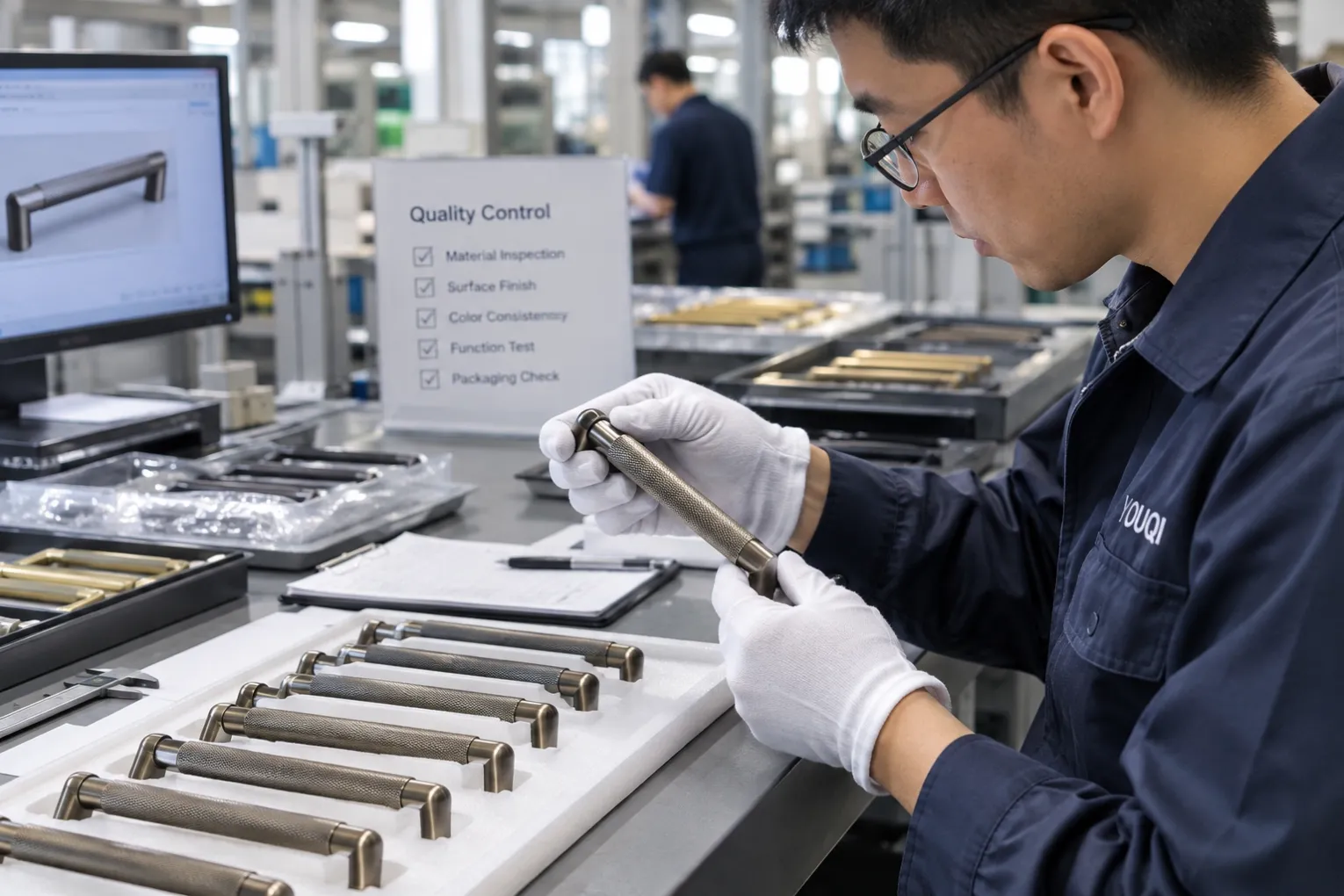
8. Quality Inspection
Quality control is carried out throughout the manufacturing process rather than only at the final stage.
Finished cabinet hardware is inspected according to established quality standards and customer requirements.
Typical inspection items include:
- Dimensions
- Hole spacing
- Surface finish
- Color consistency
- Coating adhesion
- Structural strength
- Thread accuracy
- Assembly quality
- Appearance defects
For larger orders, sampling inspection and production batch control help maintain consistent quality across the entire shipment.
9. Packaging and Final Delivery
Once products pass the final inspection, they are carefully packaged to protect them from scratches, impacts, moisture, and other damage during transportation.
Packaging may include individual protective bags, foam, cartons, inner boxes, and customized packaging according to customer requirements.
Before shipment, the production team confirms product quantities, packaging specifications, labels, and order details.
The finished products are then prepared for delivery.
From Concept to Finished Product
A professional cabinet hardware manufacturer must control every stage of the production process. Good design alone is not enough. Material quality, precision manufacturing, surface treatment, assembly, and inspection all contribute to the final result.
At YOUQI Hardware, we focus on combining design capability, manufacturing experience, precision production, and strict quality control to provide cabinet hardware suitable for different furniture and interior applications.
Whether you need standard cabinet handles and pulls or customized hardware for a specific project, a well-controlled manufacturing process is the foundation of reliable product quality.
Conclusion
The journey from a design concept to finished cabinet hardware involves multiple carefully controlled processes. Each stage—from design and material selection to machining, polishing, surface finishing, assembly, and inspection—plays an important role in creating a high-quality product.
Understanding the manufacturing process can also help buyers make better decisions when selecting a cabinet hardware supplier.
Quality cabinet hardware starts with good design and is completed through precise manufacturing.