Aug 13, 2026Buying Guides
Cabinet Handle Sizes Guide: Understanding Hole Spacing, Length and Installation
Learn how to choose cabinet handle sizes, understand hole spacing and overall length, and install the right hardware for kitchens, wardrobes, and furniture projects.
Cabinet Handle Sizes Guide: Understanding Hole Spacing, Length and Installation
Choosing the right cabinet handle size is an important part of furniture design. The size of a cabinet handle affects not only the appearance of a cabinet or drawer but also its usability and overall proportions.
Whether you are selecting hardware for a kitchen, wardrobe, bathroom vanity, or furniture project, understanding hole spacing, handle length, and installation requirements can help you make the right choice.
This guide explains common cabinet handle measurements, center-to-center hole spacing, overall length, and installation considerations for modern furniture projects.
Why Cabinet Handle Size Matters
Cabinet handles are relatively small components, but they can have a significant impact on the overall appearance of furniture.
The right handle size can:
- Improve the visual proportions of cabinets and drawers
- Provide a comfortable grip
- Create a consistent furniture design
- Improve everyday functionality
- Enhance the overall appearance of the hardware
For modern furniture projects, handle size is usually considered together with cabinet dimensions, handle profile, material, finish, and installation position.
Understanding Cabinet Handle Hole Spacing
One of the most important measurements when selecting cabinet handles is hole spacing.
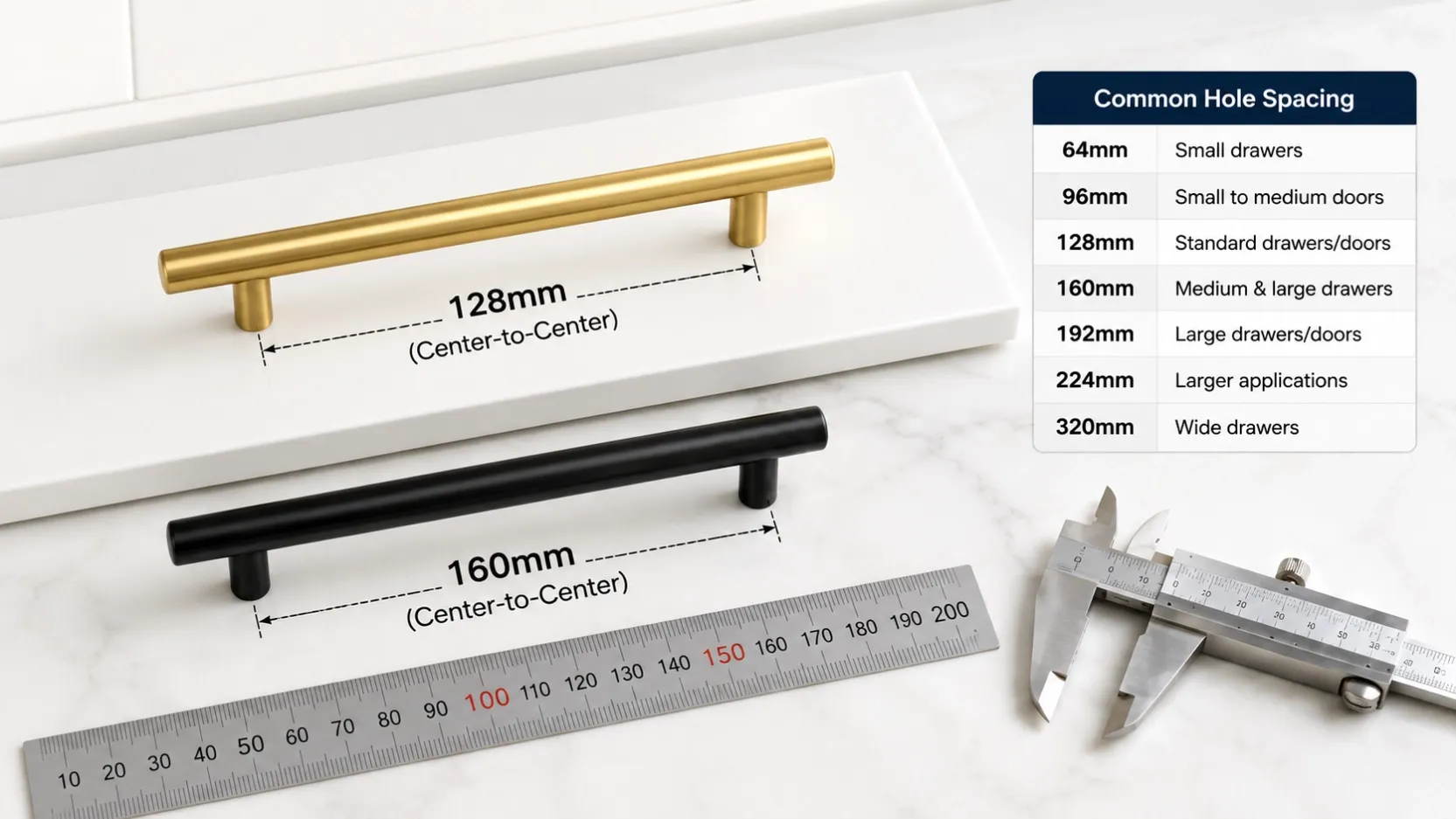
Hole spacing, also called center-to-center spacing, refers to the distance between the centers of the mounting holes.
For example, a cabinet handle with 128 mm hole spacing has two mounting holes positioned 128 mm apart.
Hole spacing is especially important when replacing existing cabinet hardware because the new handle needs to match the existing mounting holes.
It is important to remember that hole spacing is not the same as the overall handle length.
Common Cabinet Handle Sizes
Cabinet handles are available in a wide range of sizes to suit different furniture applications.
Common center-to-center hole spacing options include:
- 64 mm
- 96 mm
- 128 mm
- 160 mm
- 192 mm
- 224 mm
- 320 mm
Smaller sizes are generally suitable for compact cabinet doors and drawers, while longer handles are often used for large drawers, tall cabinet doors, wardrobes, and contemporary furniture.
The ideal size depends on the dimensions and proportions of the furniture.
Cabinet Handle Hole Spacing vs. Overall Length
When selecting cabinet hardware, it is important to distinguish between hole spacing and overall handle length.
Hole Spacing
Hole spacing is the distance between the centers of the mounting holes.
This measurement is particularly important when replacing existing cabinet handles.
For example, if an existing handle has a 128 mm center-to-center measurement, a replacement handle should normally use the same hole spacing unless the cabinet is being modified.
Overall Length
Overall length refers to the complete length of the handle from one end to the other.
A handle with 128 mm hole spacing may have an overall length of approximately 140–160 mm depending on its design.
For replacement projects, always confirm the hole spacing before ordering.
How to Choose the Right Cabinet Handle Size
Different furniture applications often require different handle sizes.
Small Cabinets and Drawers
For smaller cabinet doors, bathroom cabinets, and compact furniture, 64 mm or 96 mm handles can provide a balanced appearance.
These smaller sizes are suitable when the cabinet front has limited space or when a subtle hardware design is preferred.
Standard Kitchen Cabinets
128 mm and 160 mm handles are versatile options for many kitchen cabinet and furniture applications.
They provide a comfortable grip while maintaining a clean and proportional appearance.
Large Drawers
Large drawers can benefit from longer handles such as 192 mm, 224 mm, or 320 mm.
Longer pulls can create better visual balance across a wide drawer front and provide a more comfortable grip.
Tall Cabinet Doors
Long cabinet handles are often used on tall pantry doors, wardrobes, and full-height furniture.
Installing a long handle vertically can also emphasize the height of the cabinet and create a modern architectural appearance.
How to Measure Existing Cabinet Handles
If you are replacing existing cabinet hardware, accurate measurement is essential.
Step 1: Measure the Hole Spacing
Measure from the center of one mounting hole to the center of the other mounting hole.
Do not measure from the outside edges of the holes.
Step 2: Measure the Overall Length
Measure the complete length of the existing handle.
This allows you to compare the visual proportions of replacement products.
Step 3: Measure the Projection
Projection refers to how far the handle extends from the cabinet surface.
This measurement affects both comfort and the visual profile of the hardware.
Step 4: Check Cabinet Thickness
Make sure the mounting screws are suitable for the thickness of the cabinet door or drawer.
Correct screw length helps ensure secure installation without damaging the furniture.
Cabinet Handle Size and Furniture Design
Handle size should work together with the overall furniture design.
Modern minimalist furniture often uses clean and simple handles, while traditional furniture may use smaller pulls, knobs, or decorative hardware.
For contemporary kitchens, designers may combine several handle sizes according to the dimensions of different doors and drawers while maintaining consistent finishes and profiles.
The goal is not necessarily to use one size everywhere, but to create a consistent visual relationship across the entire furniture collection.
Horizontal or Vertical Cabinet Handle Installation?
Cabinet handles can generally be installed horizontally or vertically depending on the application.
Horizontal handles are commonly used on:
- Kitchen drawers
- Base cabinets
- Wall cabinets
- Dressers
- Storage furniture
Vertical handles are often used on:
- Tall cabinet doors
- Wardrobes
- Pantry doors
- Full-height furniture
The installation direction can change the visual appearance of the furniture and should be considered together with the handle length and cabinet proportions.
Cabinet Handle Installation Considerations
Proper installation is important for both appearance and long-term performance.
Before drilling mounting holes, consider:
- Handle hole spacing
- Cabinet door or drawer dimensions
- Handle position
- Cabinet thickness
- Screw length
- Installation direction
- Clearance around the handle
For new furniture production, using an installation template can help maintain consistent positioning across multiple cabinet doors and drawers.
For larger furniture projects, consistent hole positioning is especially important because even small differences can become noticeable across a complete kitchen or wardrobe installation.
Cabinet Handle Sizes for OEM Projects
For furniture manufacturers, designers, distributors, and project buyers, standard cabinet handle sizes may not always meet specific requirements.
OEM and ODM cabinet hardware projects may require:
- Custom hole spacing
- Custom overall length
- Custom handle profiles
- Different materials
- Custom surface finishes
- Private-label production
- Custom packaging
Professional cabinet hardware suppliers can develop products according to technical drawings, samples, or specific project requirements.
For larger projects, dimensions, tolerances, materials, finishes, mounting hardware, and packaging should be confirmed before bulk production.
Common Mistakes When Choosing Cabinet Handle Sizes
Choosing Only by Overall Length
Overall length does not determine whether a replacement handle will fit existing mounting holes.
Always confirm the center-to-center hole spacing.
Choosing a Handle That Is Too Small
A short handle on a wide drawer may look visually unbalanced and may not provide the most comfortable grip.
Choosing a Handle That Is Too Large
An oversized handle can dominate a small cabinet door and make the furniture appear visually heavy.
Using Too Many Different Sizes
Using many different sizes without a clear design system can make a furniture collection look inconsistent.
A small selection of coordinated sizes is often more effective.
Ignoring Handle Projection
The handle should provide sufficient clearance for comfortable use without extending unnecessarily far from the cabinet surface.
Cabinet Handle Size Comparison
Hole Spacing | Typical Application | Design Character |
|---|---|---|
64 mm | Small drawers and cabinets | Compact and subtle |
96 mm | Small to medium cabinets | Balanced and versatile |
128 mm | Standard kitchen cabinets | Classic and practical |
160 mm | Medium and large drawers | Modern and comfortable |
192 mm | Large drawers and doors | Strong and proportional |
224 mm | Wide drawers and furniture | Contemporary |
320 mm | Large drawers and tall doors | Bold and architectural |
These are general guidelines rather than fixed rules. The best size depends on the furniture dimensions, design style, and intended use.
Choosing Cabinet Handles for Modern Furniture
Modern furniture often benefits from simple proportions and consistent hardware.
Popular approaches include:
- Using 128 mm or 160 mm handles for standard cabinets
- Using longer handles on wide drawers
- Using vertically installed handles on tall doors
- Matching handle sizes across the same furniture collection
- Combining different sizes while keeping the same profile and finish
For example, a kitchen may use 128 mm handles on standard drawers, 160 mm handles on larger drawers, and longer handles on tall pantry doors.
This creates visual consistency while allowing each piece of hardware to match the scale of the furniture.
Conclusion
Choosing the right cabinet handle size requires more than simply selecting a product based on appearance.
Hole spacing, overall length, projection, cabinet dimensions, installation direction, and furniture style should all be considered.
For replacement projects, start by measuring the existing center-to-center hole spacing.
For new furniture projects, select coordinated handle sizes according to the proportions and intended use of each cabinet or drawer.
YouQi Hardware Supply provides cabinet handles and related hardware solutions for kitchens, furniture, wardrobes, and interior projects, with OEM and ODM support for customized requirements.